
Twenty years of learning. Ten years independent.
20 years of learning. Still moving forward.
From a pioneering research question to a national charity helping young people — and the adults around them — build psychological fitness for life.
Where we began
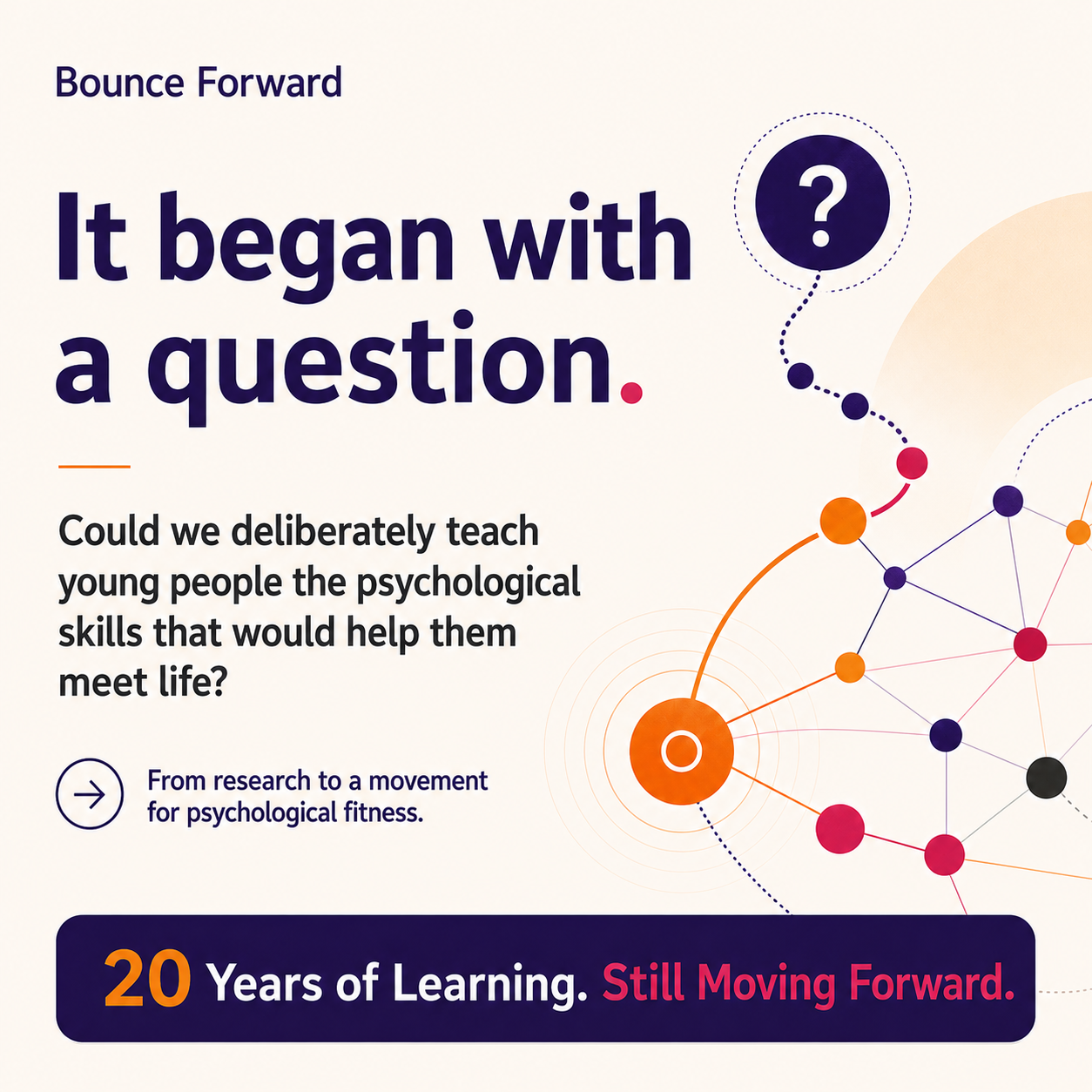
It began with a question.
Nearly twenty years ago, Bounce Forward did not begin with a brand, a programme or a business plan.
What began in research has grown into nearly twenty years of learning about resilience, emotional wellbeing, prevention and, ultimately, psychological fitness.
The language has evolved, but the underlying belief has remained remarkably consistent: children should not have to become unwell before we teach them the skills that help them meet life.
Could we deliberately teach young people the psychological skills that would help them meet life?
Our journey
From research to a movement for psychological fitness.
An idea that began inside a research project — and refused to stay there.
-
2007
The question becomes research
The Penn Resilience Programme is brought to UK schools and tested with young people.
Read more
The pioneering Local Wellbeing Project driven by Lord Richard Layard brought together Hertfordshire County Council, Manchester City Council, South Tyneside, The Young Foundation, the University of Pennsylvania and the Department for Education. The research looked to understand the impact of teaching resilience to young people as a lesson in school.
The evaluation followed 4,000 children over three years and found measurable improvements in depression symptoms and attendance for children taught the lessons compared to those who weren't — with important findings for young people facing greater disadvantage.
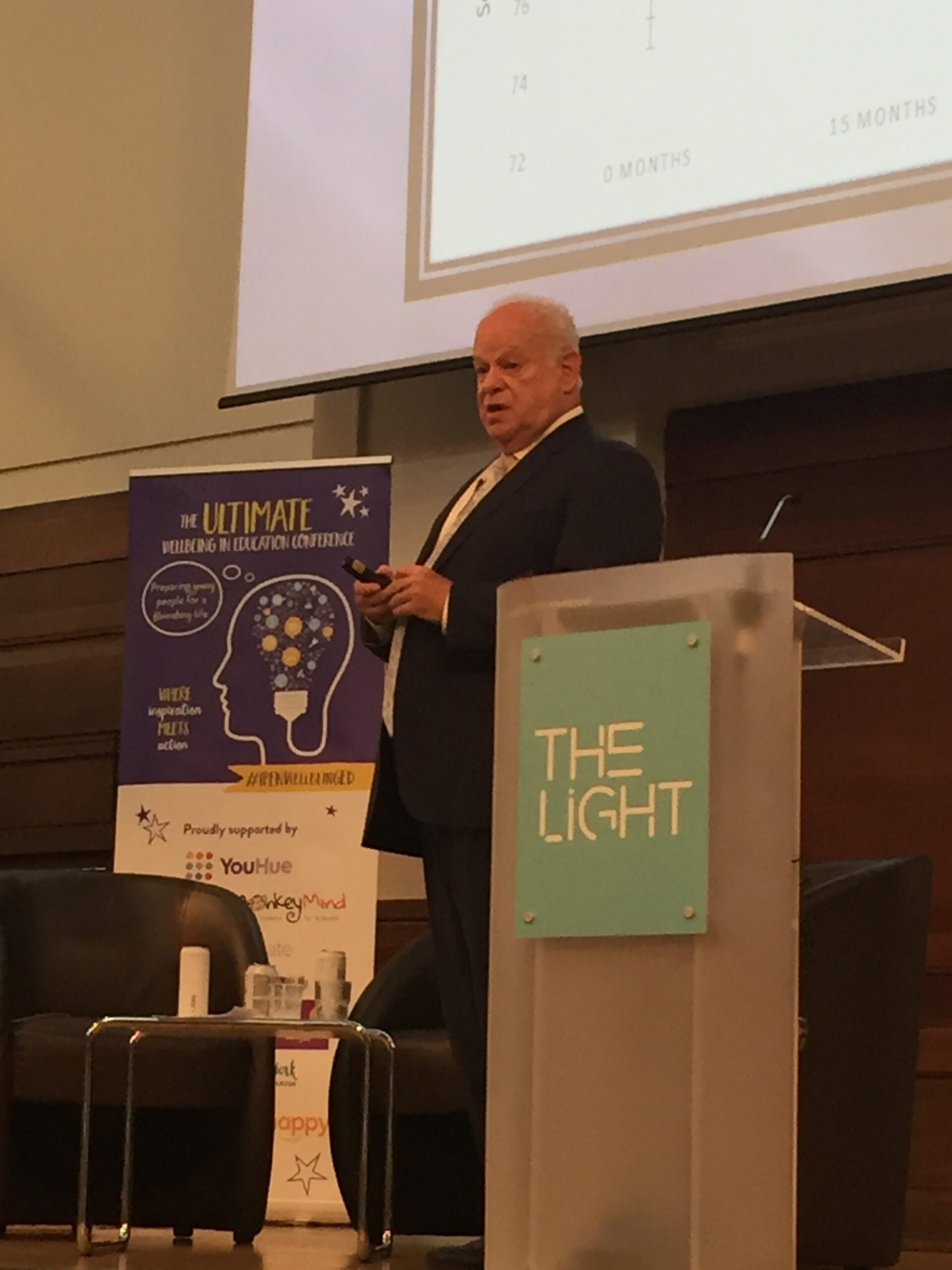
Professor Martin Seligman 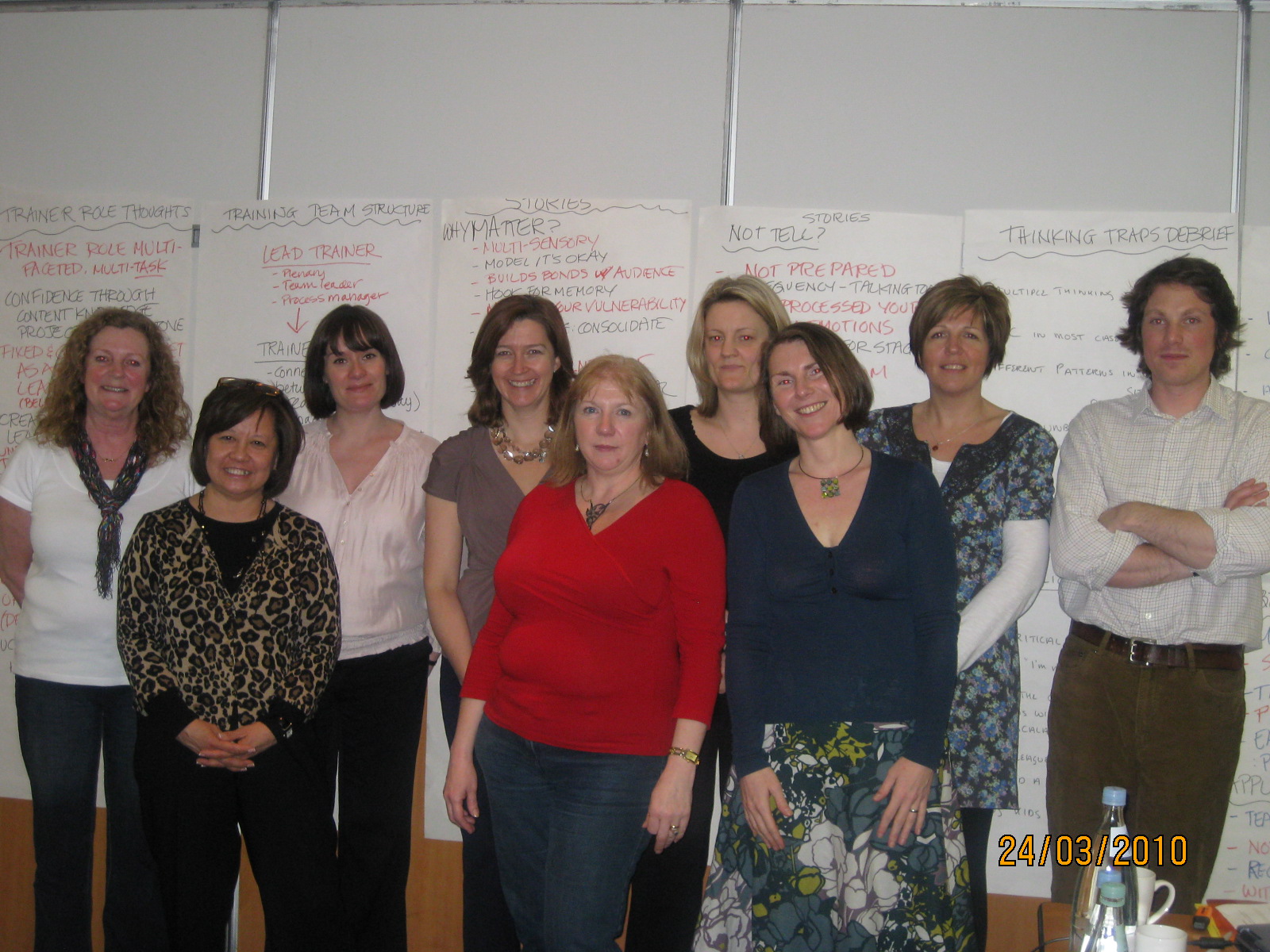
Early Herts PRP team -
2012
Healthy Minds takes shape
Financially self-sufficient, the work secures £1.3 million from the Education Endowment Foundation for a broader, evidence-informed secondary curriculum.
Read more
Growing inside Hertfordshire County Council under the name How to Thrive, we built a UK training team with the University of Pennsylvania. Helped by Lord Layard, building on the PRP research this Randomised Controlled Trial asked a bigger question: what happens when young people learn these capabilities throughout their secondary-school journey?
Healthy Minds followed more than 9,500 young people across 34 brave and pioneering schools over five years, independently evaluated by the London School of Economics and National Institute of Economic and Social Research.
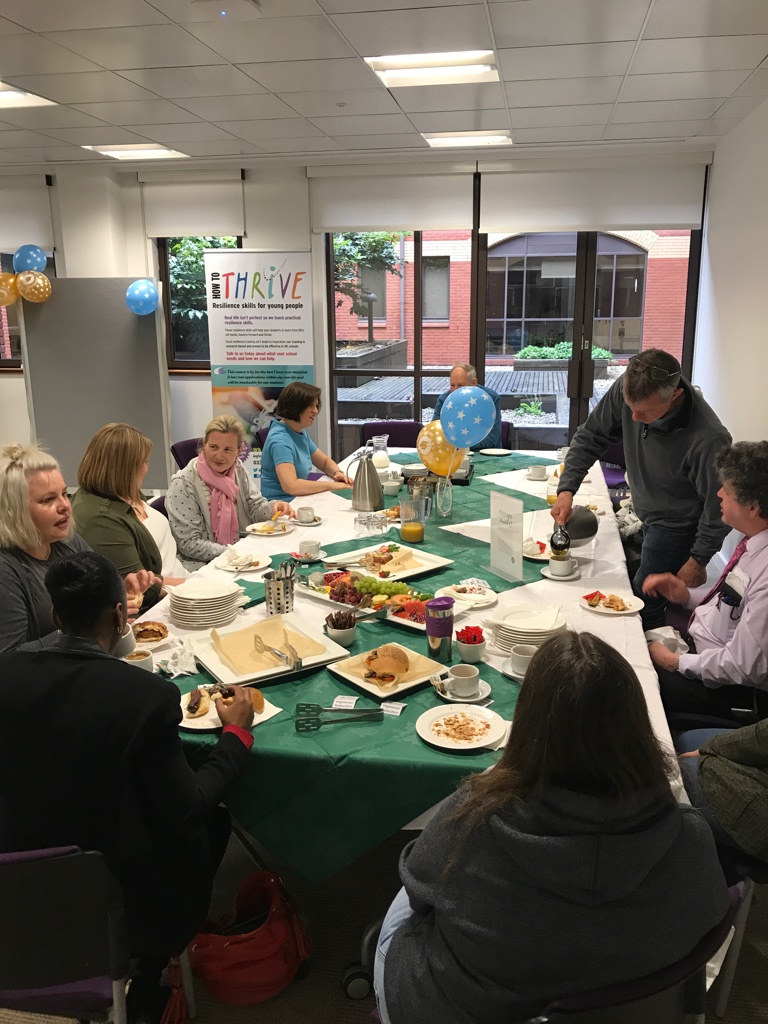
How to Thrive celebration 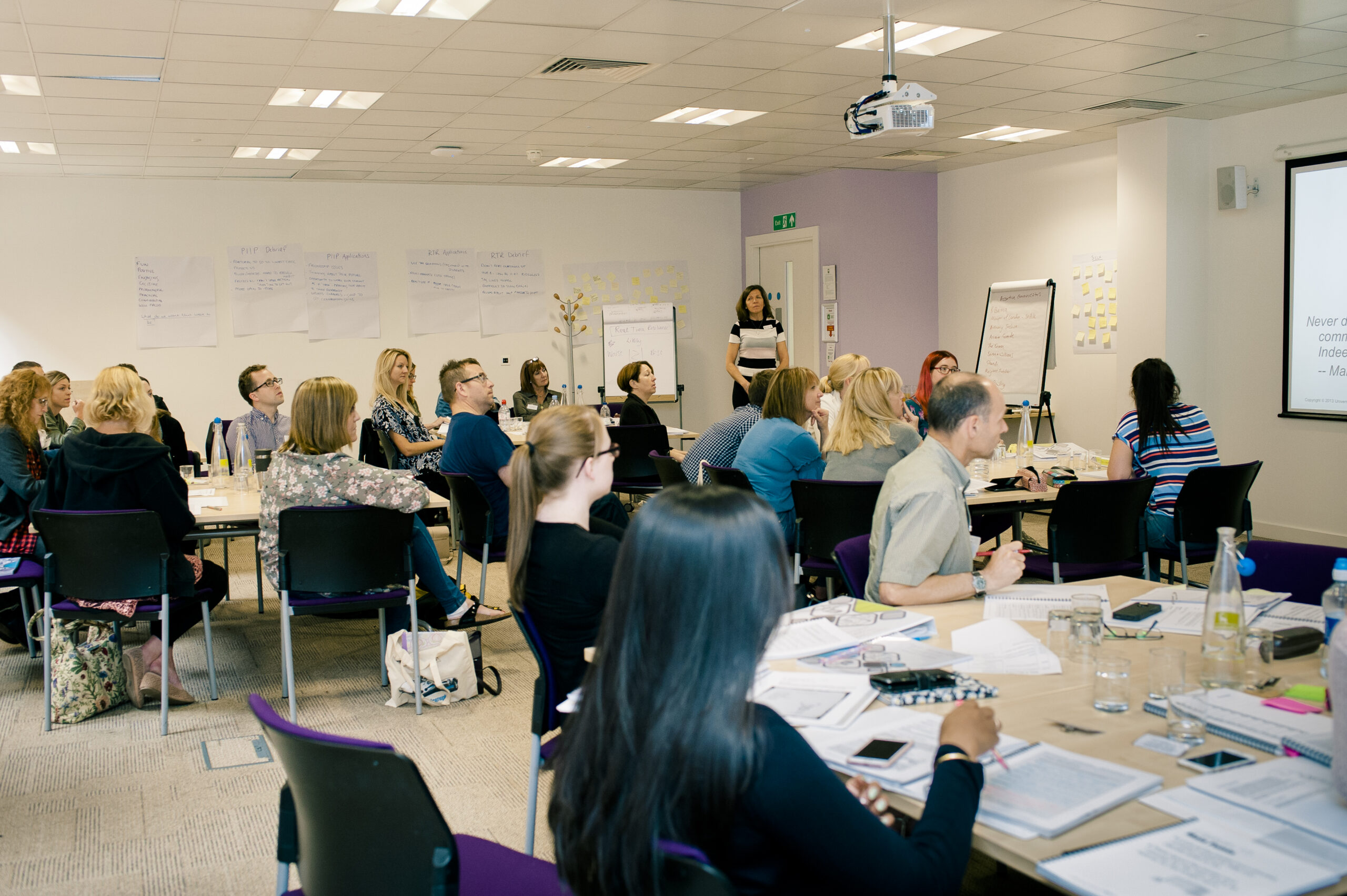
Healthy Minds Training -
2016
A new chapter of independence
In December 2016, the work became an independent charity.
Read more
Independence did not mean certainty. We were asking whether a small charity could turn evidence developed through public-sector partnership and major research into sustainable change.
We developed programmes, trained thousands of teachers and parents, and learned how hard it can be to fund work designed to prevent problems rather than respond once they become acute.
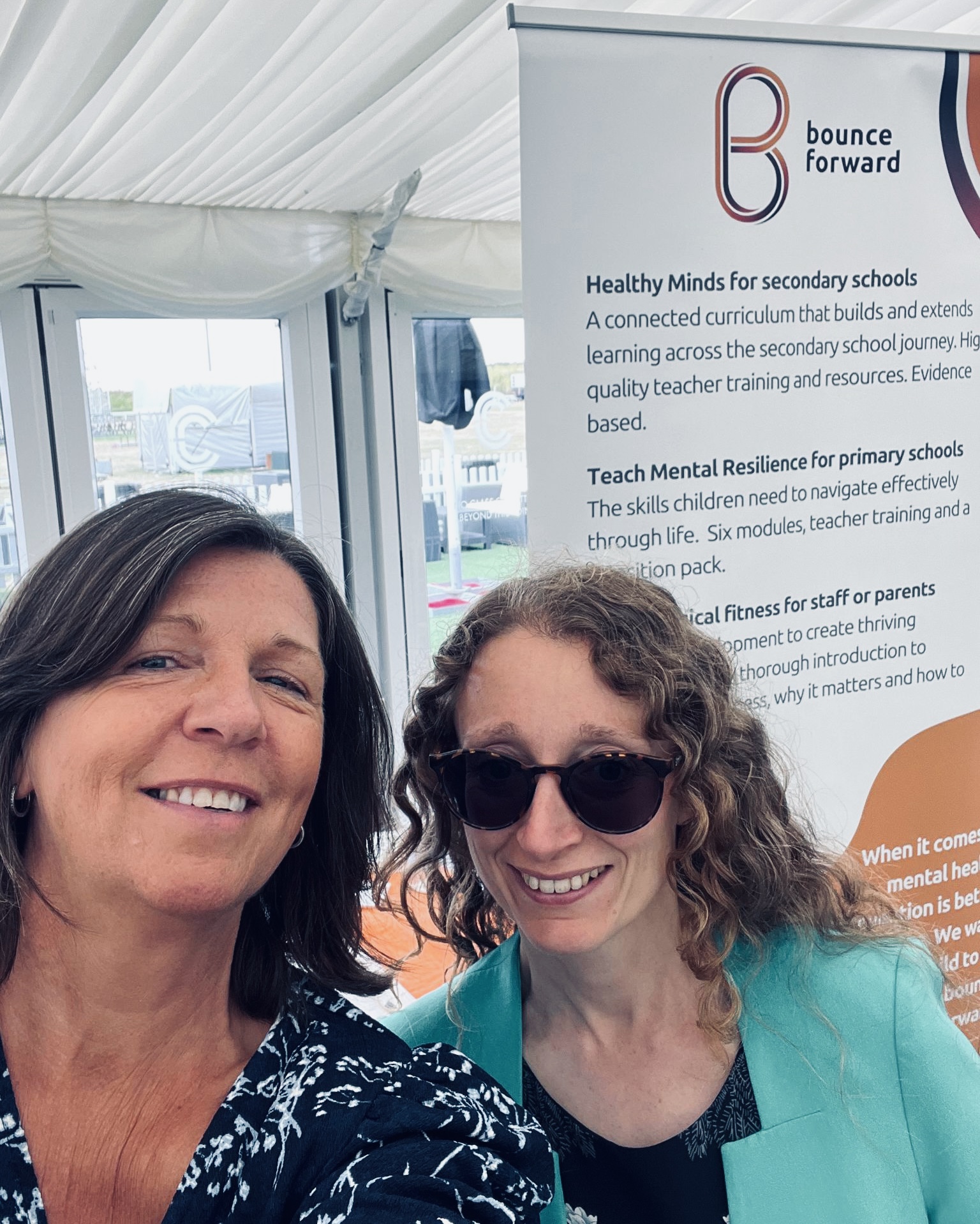
Lucy and Pooky Knightsmith, Author 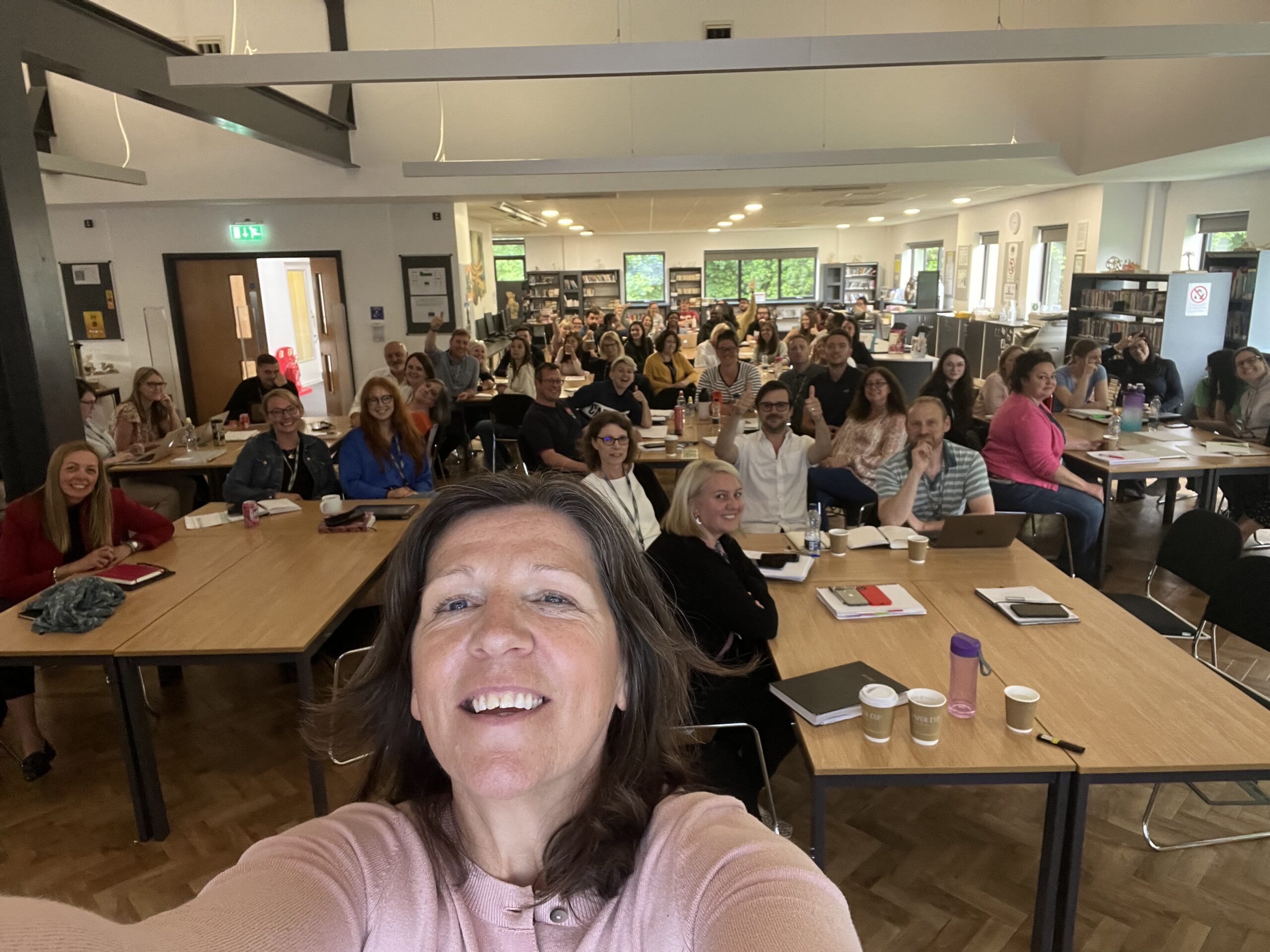
Teacher Training -
2018
Bounce Forward is born
A trademark challenge meant How to Thrive could no longer continue. After a six-month rebrand, a new name reflected the organisation's ambition — and its own resilience.
Read more
At the time, changing our name felt like disruption. Looking back, it feels strangely fitting: “Bounce Forward” came to describe not simply what we wanted to teach, but something of the organisation itself.
Richard Layard again stepped in to support, hosting the launch of Bounce Forward at the House of Commons.
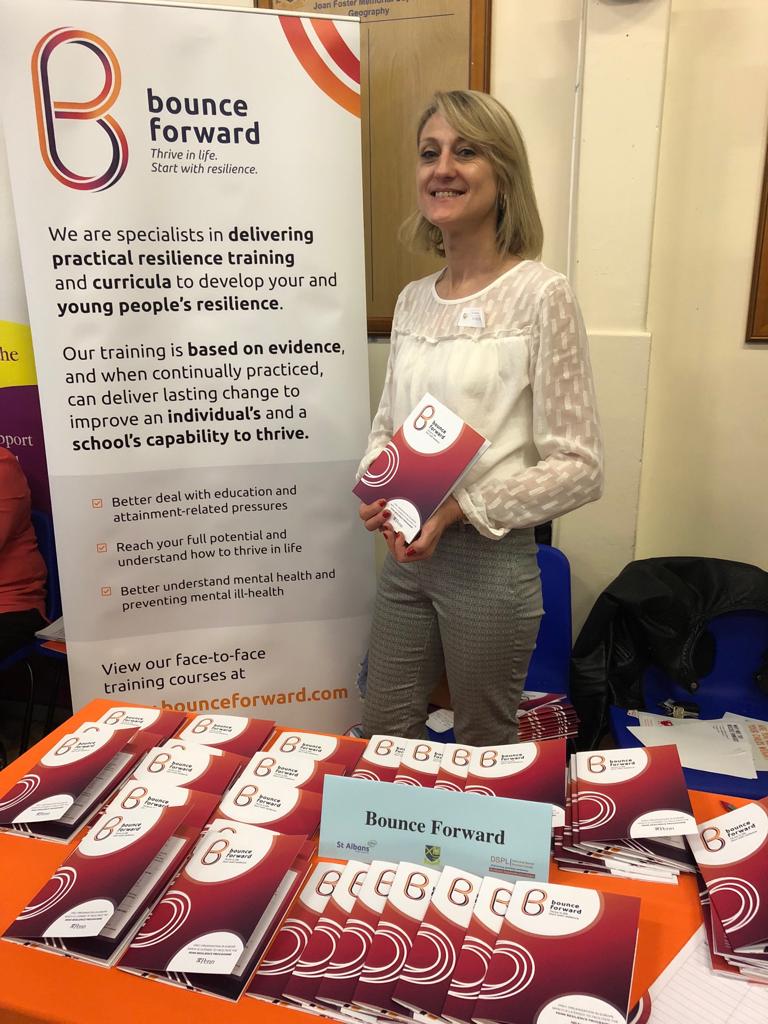
Julie Newbury 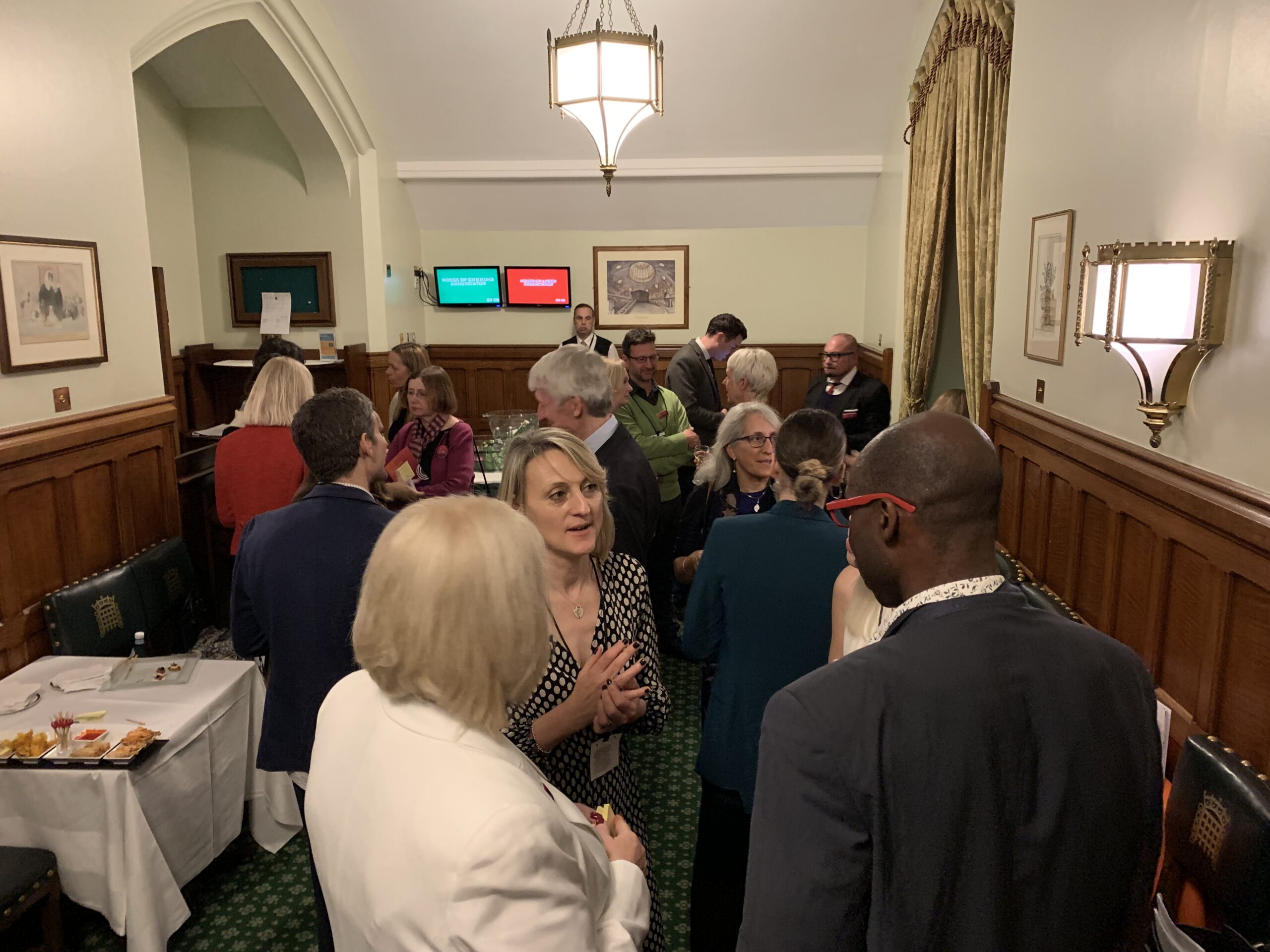
House of Lords Launch -
2020
Adapting and reaching families
Covid removed our face-to-face model almost overnight. Training moved online, resources became digital and our work with parents grew rapidly.
Read more
There was no clever strategic plan waiting in a drawer. We furloughed staff, drew on volunteers and pro-bono support, and challenged our own assumptions about what could be done online.
Since 2020, our parent work has reached more than 30,000 parents and carers — translating psychology into ideas that can be used around kitchen tables, in cars and during difficult conversations.
Thank you, Elisha and Amy
Some people come into your working life and become so much more than a colleague.
We met Elisha during Covid, when Bounce Forward was navigating extraordinary uncertainty. I often say that once we found her, we weren't going to let her go! Since then, she's helped us navigate challenges, create opportunities and quietly shaped so much of who we are today. But it's who she is that matters most. Thoughtful, courageous and compassionate, Elisha listens deeply, challenges assumptions and isn't afraid of difficult conversations. She is wonderfully human. She doesn't pretend that growth is easy or that getting things right is always straightforward. She understands that sometimes psychological fitness means sitting with discomfort, recognising an old pattern, making a different choice and trying again. I see that in the way she works, the way she leads, the way she cares about people and the way she approaches being a mum. For an organisation built around the belief that psychological skills can be learned, practised and strengthened throughout life, having someone who genuinely lives those principles is a privilege.
Amy Bradshaw is one of those remarkable people who turns belief into action. As a senior leader, she has embedded Healthy Minds across her Trust, welcomed Harry & Kate Kane and the BBC into her school to see the work in action. She helped shape and write Intentional Stillness curated with Kate Kane. As a Bounce Forward Associate Trainer, she has also supported thousands of parents. But Amy doesn't just champion psychological fitness — she lives it. Navigating significant, longstanding challenges with her own health, she knows firsthand what it means to regulate, recover and adapt, even on the hardest days. Her warmth, courage, determination and generosity are extraordinary, and we feel incredibly privileged to have her alongside us.
Thank you, to Elisha and Amy, for everything you do and for helping our ideas travel so much further.
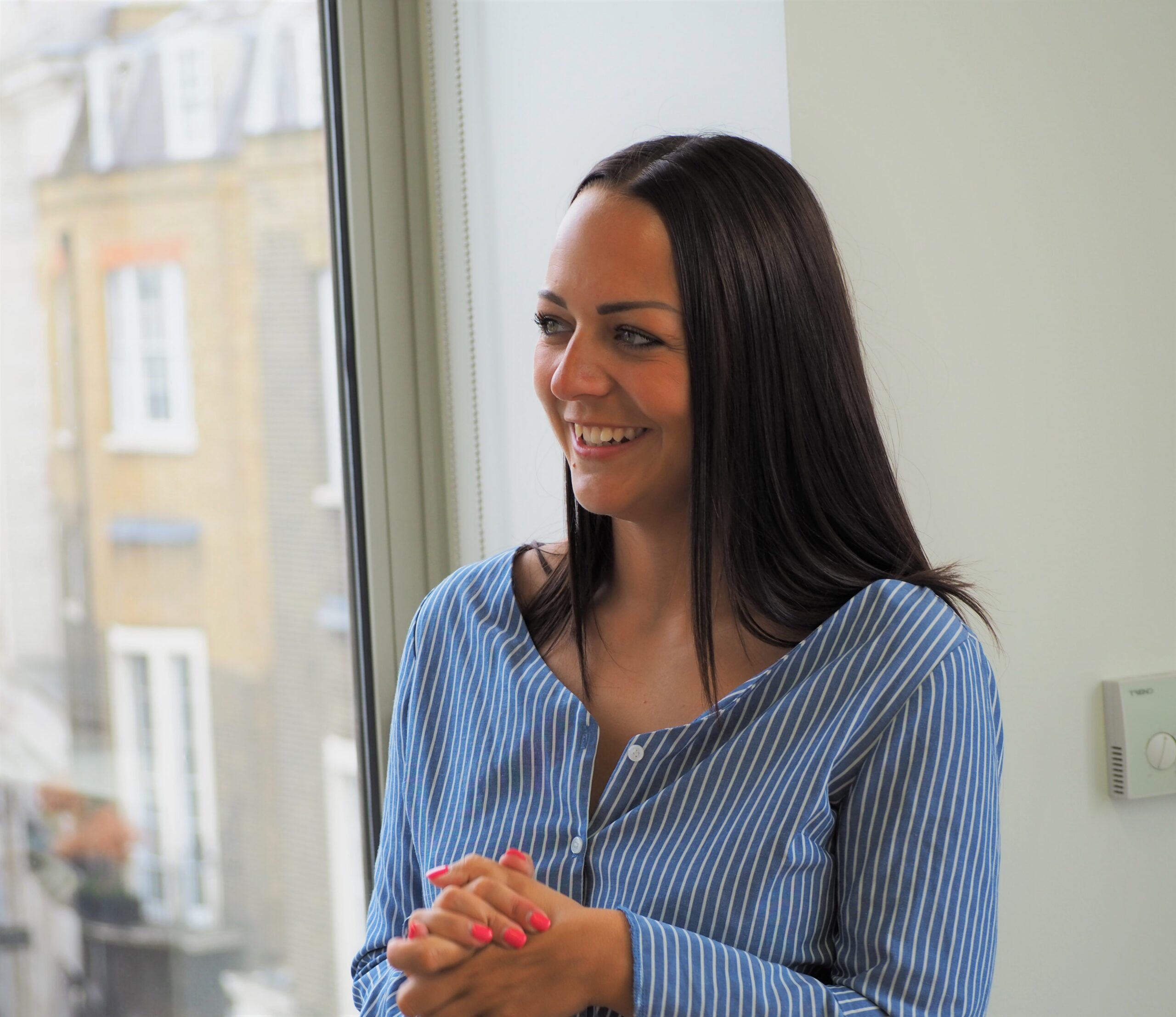
Elisha 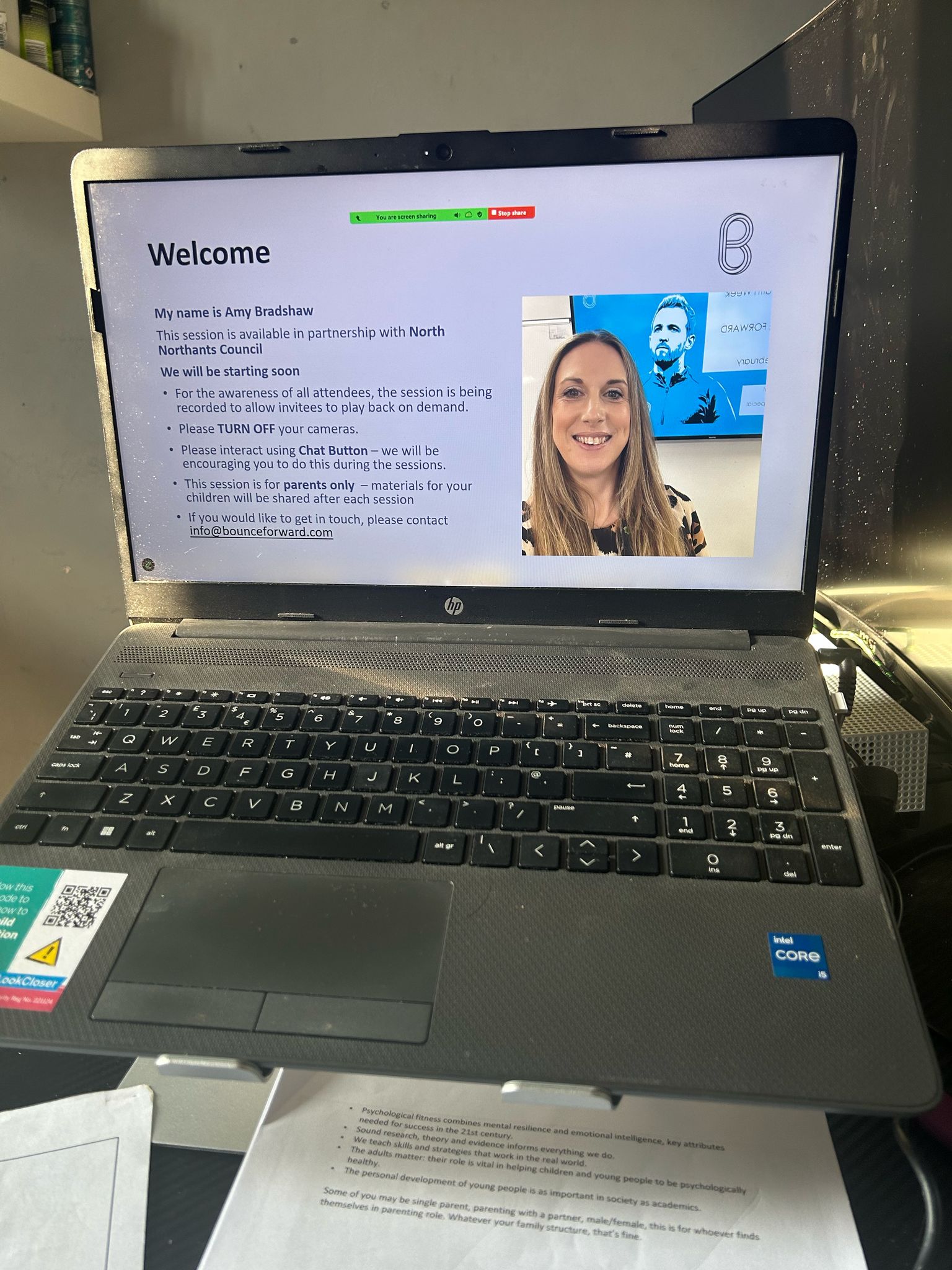
Amy Bradshaw, Raise Resilience online -
2022
Powerful partnerships. Extraordinary possibilities.
Our partnerships with the Harry Kane Foundation and Carlsberg Britvic have been transformational, helping us bring psychological fitness to thousands of children, young people, teachers and parents across England. Together, they have extended our reach and shown what becomes possible when organisations share a commitment to prevention and preparing young people for life.
Read more
Some of the relationships we have built along the way are among the things of which we are most proud.
Our story of partnership stretches back to our beginnings with Hertfordshire County Council that paved the way and set the standard. To our work with Oldham Council starting in 2018 reaching every school, training 100s of teachers and reaching 1000s of parents. From KMT Teacher Training, to embed skills as part their wider support package to our place within the Big Change community, these relationships have helped us turn research into practice, strengthen communities and bring psychological fitness into the lives of children and the adults around them.
Along the way, organisations including KJ Smith, Accenture and the Strategic PA Network have opened doors, connected us with new opportunities and helped our work travel further than we could have imagined.
Across nearly twenty years, our work has reached more than a million children and young people. Behind that impact are countless people and organisations who have believed in what we are trying to achieve.
Because no small charity changes a system alone.
Ideas travel through people. And change happens when others carry them too.
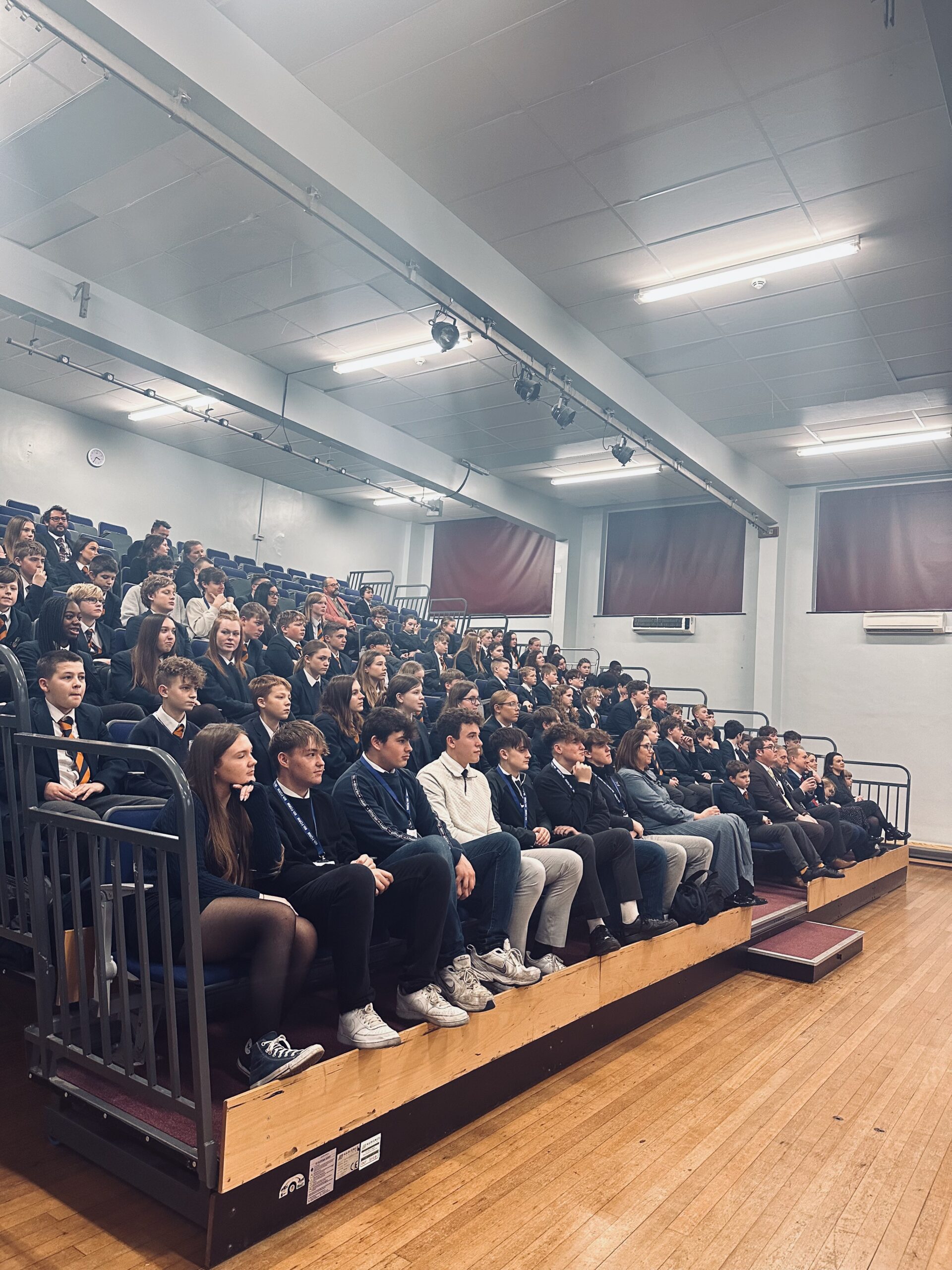
Reaching children across the UK -
2026
20 years of learning. A bigger ambition.
What if psychological fitness became as much a part of growing up as learning to read and write?
Twenty years of research and experience have brought us to this moment. We know psychological skills can be taught. Now our ambition is to make them part of everyday life — built into school cultures, experienced through real-world challenge and practised within families.
Read more
Nearly twenty years ago, we began with a question. Today, our understanding has grown, and so has our ambition.
Research remains at the heart of our work. It has challenged our thinking, strengthened our understanding and shown us that developing psychological fitness is about more than teaching individual skills. Relationships, experiences and the environments around children matter enormously.
With BounceTogether and Build What Lasts, we're connecting meaningful insight into the experiences of pupils, staff and families with practical action. Helping schools move beyond isolated wellbeing initiatives towards a whole-community approach: Listen. Understand. Strengthen. Review.
Our partnership with PGL Beyond takes learning beyond the classroom. Through Bounce Beyond, children and young people prepare for challenge, practise psychological skills in real situations and learn to carry those experiences into school, relationships and life. Not simply having an experience, but understanding what it teaches them about what they are capable of.
And through Healthy Minds for Parents, we're making psychological fitness more accessible in everyday family life, with practical learning pathways, a supportive community and free Psychological Fitness Nana resources. Because parents need these skills for themselves, not simply to teach them to their children.
These developments share one ambition: to make psychological fitness something that is understood, modelled, practised and strengthened throughout life.
We began by asking what we could teach children. Now we're asking what we can build around them.
Bounce Forward. Build what lasts.
The impact
The numbers tell part of the story.
Twenty years of research, practice, setbacks, partnerships and lived experience.
20Years of research, practice and learning10Years as an independent charity30,000+Parents and carers reached through our parent work since 2020100,000+Young people reached directly through the Harry Kane Foundation partnership aloneHealthy Minds One of the most substantial longitudinal studies of sustained life-skills teaching in UK secondary education — with no adverse effect on exam results.
9,500+young people34schools5yearsBut some of the most important outcomes are harder to count. A parent who listens differently. A teacher who pauses before reacting. A young person who learns that a thought isn't necessarily a fact.
What the years have taught us
10 things we've learned in 20 years.
These are not achievements. They are things nearly two decades of evidence, practice and listening have taught us.
A thought is not necessarily a fact.
What we believe about an event shapes how we feel and what we do next. Learning to notice and challenge unhelpful thinking can change the response.
Resilience is not about being tough.
It is not avoiding difficult emotions or pretending everything is fine. It is developing the capacity to regulate, recover and adapt when life does not go to plan.
Children learn from what adults model as much as what adults teach.
How adults respond to pressure, mistakes, disagreement and uncertainty becomes part of the environment in which children develop.
Prevention cannot begin only when a problem becomes visible.
Early intervention matters. But development begins before there is a problem to solve.
Connection is part of psychological fitness.
Knowing how to build relationships, reach out, listen, repair and seek support are skills for life.
Hope is not wishful thinking.
Hope grows when people can see possible pathways forward and believe they have some agency in taking the next step.
Adults need psychological fitness too.
Parents, teachers and leaders are not simply responsible for developing it in children. Their own capacity matters.
What happens around a child shapes what becomes possible within them.
Children do not develop in isolation. Relationships, environments, expectations and opportunities matter.
Evidence matters. So does implementation.
A good programme on paper is not enough. What matters is whether people understand it, use it and carry it into everyday life.
Teaching wellbeing does not have to come at the expense of academic learning.
Healthy Minds research found important health and wellbeing outcomes without adversely affecting academic attainment.
20 years of learning. Still moving forward.
Then and now
The mission didn't change. Our understanding grew.
ThenNowResiliencePsychological fitnessTeach childrenDevelop the ecosystem around childrenInterventionDevelopmentFace-to-face trainingLearning that can travelA school programmePupils, staff and familiesMeasure outcomesListen. Understand. Strengthen. Review.Prevent mental ill-healthBuild capability for lifeNearly twenty years of learning has not taken us away from the original question. It has made the question bigger.
We had to practise it too
Resilience is what happens when reality is not what we expected.
For nearly twenty years, we have taught people that resilience is not about avoiding difficulty. Somewhere along the way, Bounce Forward had to learn that lesson too.
We have operated with small teams, associates, trustees, volunteers and partners. Society spends enormous amounts responding once difficulties become severe, yet securing investment to build capability before crisis remains extraordinarily difficult. We have lived that contradiction — and we are still here.
- We faced a legal challenge to our original name, How to Thrive.
- We rebuilt as Bounce Forward.
- We navigated financial uncertainty.
- Covid removed our face-to-face delivery model almost overnight.
- We moved training online and found new ways of reaching families.
- We made mistakes, changed direction, recovered and adapted.
That is not bouncing back. That is bouncing forward.
Stronger together
The partnerships that helped us move forward.
No small charity changes a system by guarding its ideas. Change happens when other people carry them too.
Partnership story · 2022–2026
Harry Kane Foundation
Four years of building what lasts — built on a shared belief that prevention matters, that positive mental health deserves the same seriousness as physical health and academic success, and that the adults around young people have a vital part to play.
100,000+children and young people reached directly through this partnership alone120+schools4,500parents and carers through 9 courses142schools joined Every Goal Counts during the 2026 World CupPartnership story · 2022–2026
Carlsberg Britvic
Some partnerships fund activity. The best ones create the conditions for growth. Through roadshows, site visits, parent courses and shared conversations, employees didn't just support the work — they became part of it.
Read the Carlsberg Britvic story200+schools nominated by employees40,000+children reached each yearc. £50ka year raised by employeesc. £200kdirect charity-partner funding across four years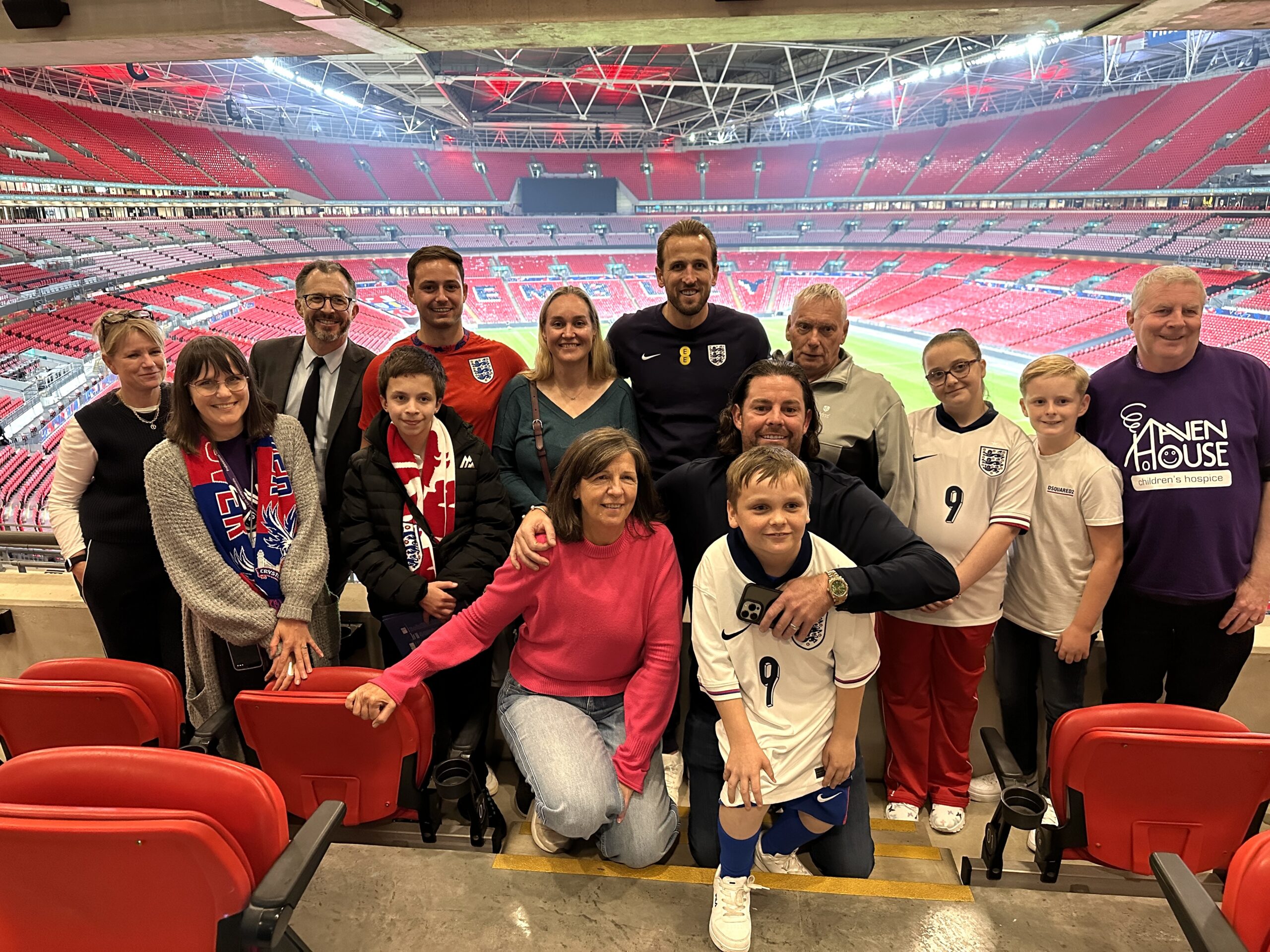
With the Harry Kane Foundation at Wembley Stadium “We're incredibly proud of our partnership with Bounce Forward and the positive impact it has had on young people, families and communities across the UK. Together, we've helped create opportunities that build resilience, confidence and a stronger future for the next generation.”
Kathryn Partridge Vice President Corporate Affairs & Sustainability, Carlsberg Britvic- Hertfordshire County Council
- Oldham Council
- Big Change
- Education Endowment Foundation
- Kent and Medway Teacher Training
- KJ Smith
- Accenture
- Strategic PA Network
- Armed Forces Covenant Fund Trust
- The Elliot Simmons Charitable Trust
- Gilead Sciences
- North Northamptonshire Council
- North Yorkshire Council
- Cambridge and Peterborough Council
- Cambridgeshire and Peterborough Council
- DSPL 8
- Aviva Community Fund
- Arnold Clark Foundation
- Sussex Police
- Gravity
- Shanley Foundation
- HMRC
School leaders
The schools and leaders who opened their doors.
We are incredibly grateful to all the schools and remarkable school leaders we have had the pleasure of working with over the years. There are too many to list here.
“We believe that education is about so much more than outcomes at GCSE. We are proud to be a Harry Kane Lead school and work with Bounce Forward so our children build the skills and attributes they need in and beyond school.”
Helen Mukherjee Upper Wharfedale School- David Croston
- Sharon Waterman
- Kate Smith
- Rhodri Bryant
- Graham Cunningham
- John Whitlock
- Pat Camp
- Matthew Job
- Linda Redgwell
- Karen Seale
- Alison Keysell
- Maxine Goodnes
- Helen Mukherjee
- Matt Coleman
- Amy Bradshaw
- Martin Serrao
- Amie King
- Robin Grover
- Helen McGlason
- Chris Ryder
- Christopher Gibbs
- Ruth Wheatley
- Tina Orchid
- Jo Thomas
- Rebecca Blake
- Darren Gadsby
- Aaron Reid
- Joanna Griffiths
- Joanna Pullen
- Jared Thress
- Martin Campbell
- Robin Whitby
- Jyoti Pettit
- Ewa Micun
- Craig Robinson
- Alex Gray
- Stuart Lindars
- Chelse Buswell
- Joe Harlow
- France Tribon
- Claire Foster
- Michael Tomlinson
- Ana Pereira
- Faiy Rushtom
- Sallie Webb
- Julie Fice
- Ewa Micum
- Mike Williams
- Amanda Read
- Sarah Baxter
- Stephen Flores
- Sarah Richford
- Matthew Linsell
- Alexa George
- Julie Mellor
- Sarah Wright
- Tina Cavanagh
- Neil Wilson
- Carlton Rose
- James Morton
- If your name should be here, please get in touch
Ideas travel through people
Behind every milestone, there are people.
People who believed in an idea when it was still uncertain. Who took professional risks, opened doors, built training, welcomed us into schools, challenged our thinking or stayed alongside us when life became difficult.
Twenty years of learning. Still moving forward.
Our story, told through the people who carried it.
Nearly twenty years of photographs, memories, challenges and extraordinary people. This film is our celebration of the journey and a heartfelt thank you to everyone who has helped make it possible.
So many people. So many stories. And so much to be grateful for.
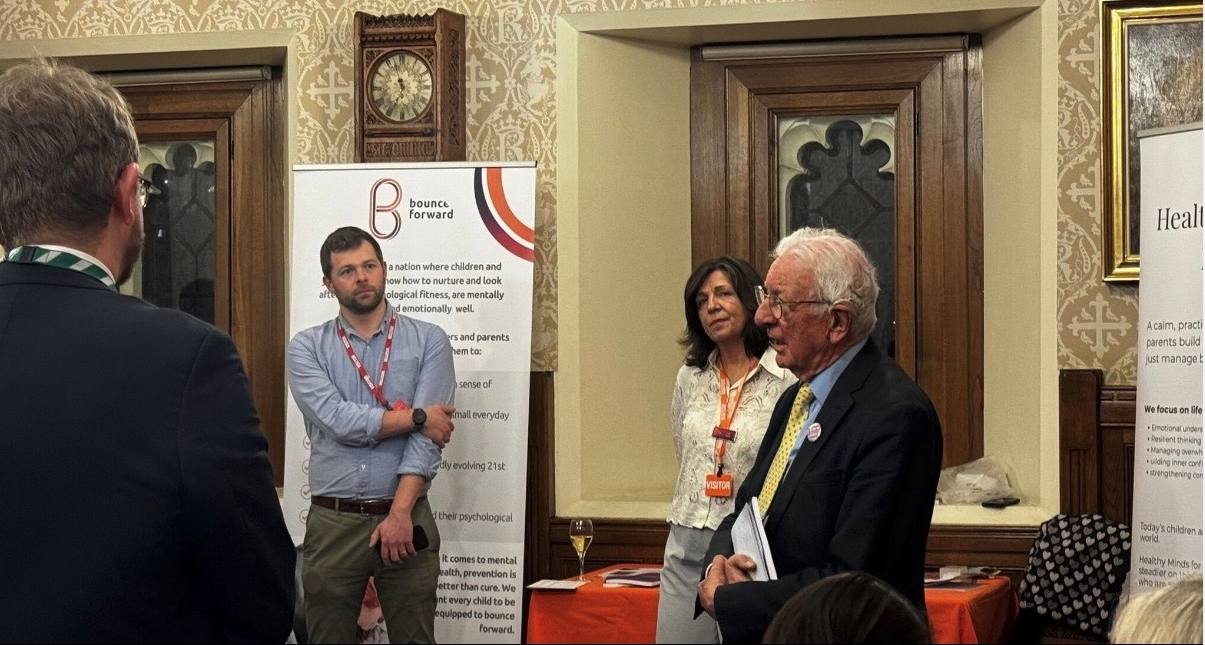 Thank you, Richard.
Without Richard Layard, Bounce Forward's story would be very different.
A personal thank you
Lord Richard Layard
One relationship. Twenty years of influence.
Richard has helped shape Bounce Forward's journey — and a much bigger movement to put happiness and wellbeing at the heart of how society measures progress. From a question in 2006 to a global movement today, he has been a constant champion: asking the big questions, building the evidence and taking it further.
Read our tribute
- 2006The question beginsThe Local Wellbeing Project asks whether emotional resilience and wellbeing can be deliberately strengthened in young people.
- 2013–18Healthy MindsA sustained, independently evaluated programme tests what happens when psychological skills are taught over time — not once.
- TodayEvidence into influenceRichard continues to champion Healthy Minds and children's wellbeing through research, policy, books, speeches and international platforms.
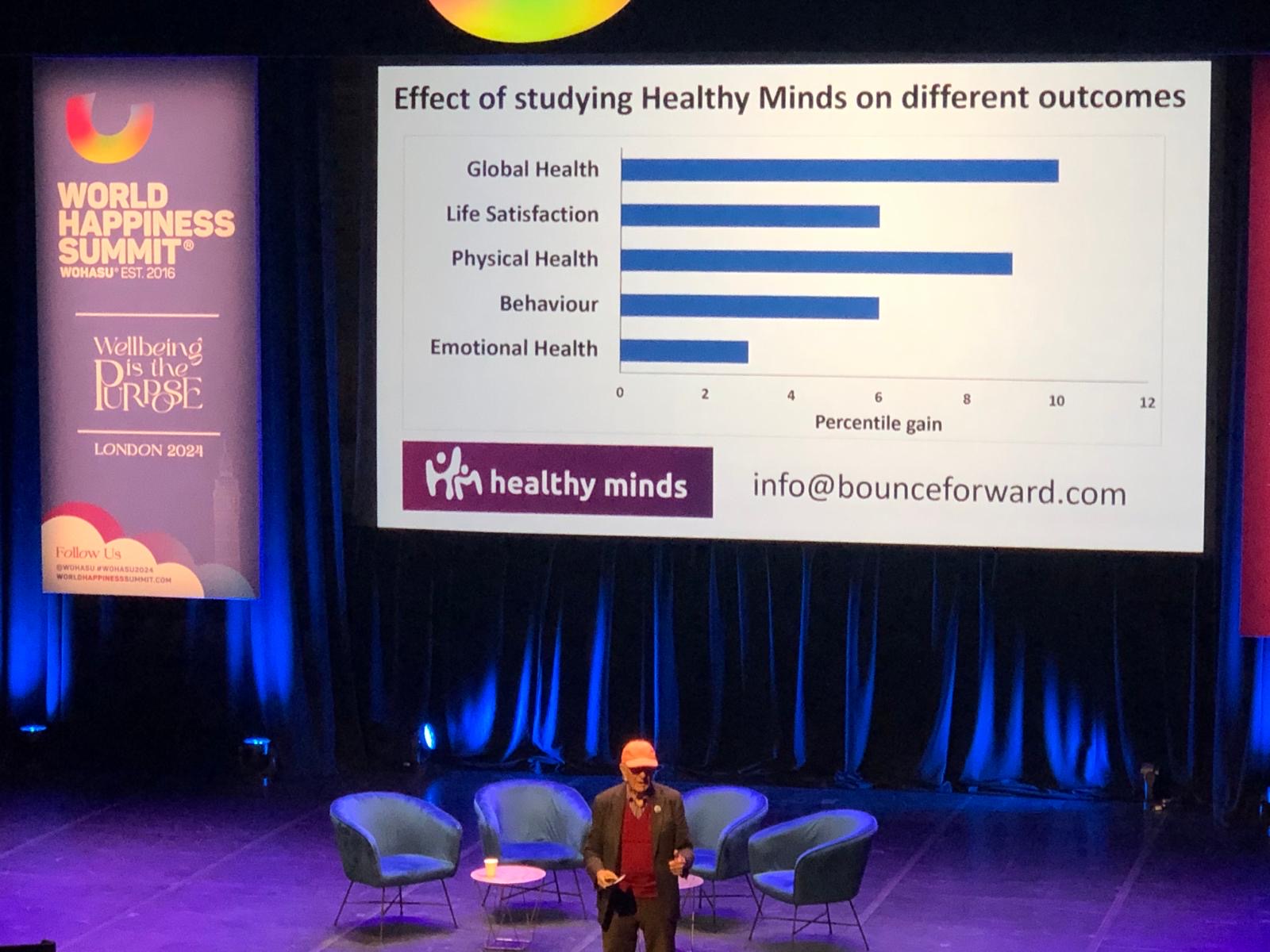
Richard has carried the evidence further, to the London School of Economics, the Education Endowment Foundation, National Institute of Social & Economic Research, the Paul Hamlyn Foundation, HM Treasury, the Department for Education, Parliament, the World Happiness Report, the World Happiness Summit and the World Wellbeing Movement.
“Happiness and wellbeing must be at the heart of how we measure progress.”
Richard Layard
Thank you, Richard. For asking the questions before they were mainstream. For insisting that happiness and wellbeing deserve serious attention. For championing Healthy Minds long after the research ended. And for repeatedly making space for Bounce Forward in the rooms where evidence, policy and influence meet.
Our gratitude goes beyond our own work — to the role he has played in making happiness and wellbeing serious measures of how well society is doing. A fairer, healthier, happier society is possible.
 Thank you, John.
For helping us understand young people before we tried to teach them.
A personal thank you
Dr John Coleman OBE
Part of the story since before Healthy Minds was Healthy Minds.
In 2013, John wrote the Conceptual Framework for Developing Healthy Minds in Teenagers, establishing a principle that continues to shape our work: if we want to teach young people skills for life, we must first understand the young people we are teaching.
Read our tribute
Working alongside Dan Hale and Richard Layard at the London School of Economics' Centre for Economic Performance, with funding from the Paul Hamlyn Foundation, John helped shape the earliest thinking behind Healthy Minds and became a central member of its steering group.
His understanding of physical, cognitive, social and emotional development helped transform a collection of evidence-informed programmes into a coherent four-year curriculum designed around the developing adolescent. From managing the world around them in Year 7, through growing autonomy, relationships and decision-making, towards preparing for adulthood.
John helped us understand not simply what young people should learn, but when, why and how.
And he didn't stop when the research stopped. As evidence and young people's lives changed, John returned to revisit the framework, reflecting developments in our understanding of the adolescent brain, social media, sleep and identity. More recently, he helped shape the adolescent sleep teaching within Physical Resilience, curated with Harry Kane, turning developmental science into practical learning young people can use.
His contribution extends far beyond Bounce Forward. Founder of the Trust for the Study of Adolescence, former Senior Research Fellow at Oxford University's Department of Education and author of All About Adolescence: Understanding Development in Today's World, John has spent his career helping adults understand adolescence more accurately. He has also generously supported our work with parents, sharing his expertise through webinars and practical guidance.
But there is another part of John's contribution that will never appear in a research report.
John has been a mentor, a source of encouragement and a friend to me throughout much of this journey. When the answers haven't been obvious, he has always been someone I could turn to, offering his extraordinary knowledge, a different perspective, a thoughtful challenge or simply kindness and encouragement.
Nearly twenty years on, John is still asking questions, still sharing what he learns and still helping us think. That curiosity and willingness to keep learning reflects something at the very heart of Bounce Forward.
Understand the young person. Recognise their stage of development and the world around them. Follow the evidence. Keep learning. And be willing to change what you do.
Thank you, John, for helping shape Healthy Minds, for continuing to strengthen our thinking, and for sharing your expertise so generously with young people, teachers and parents. And personally, thank you for your mentorship, encouragement and friendship.
Bounce Forward's story would be different without you.
Faces of the journey
Some of the people who walked alongside us.
Scroll through twenty years of faces →
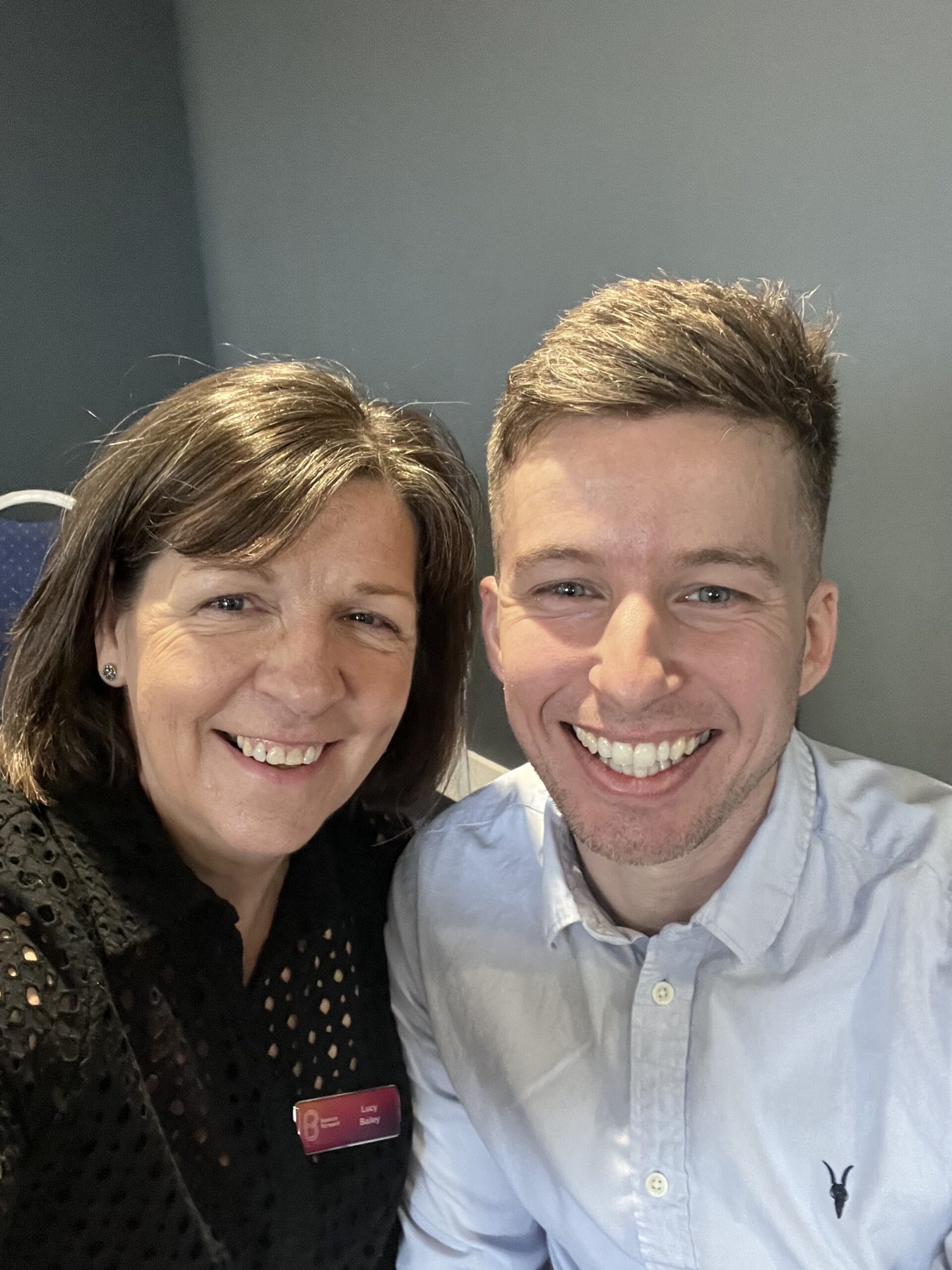
Lucy and Bob WilkinsonManaging Director, BounceTogether 
Amy BradshawTeaching Healthy Minds 
How to Thrive Team Away Day 2018 
Claire PearceGrant Provider, Somerset 
Gary RedfeatherAmbassador 
The Leigh AcademyHealthy Minds Quality Award 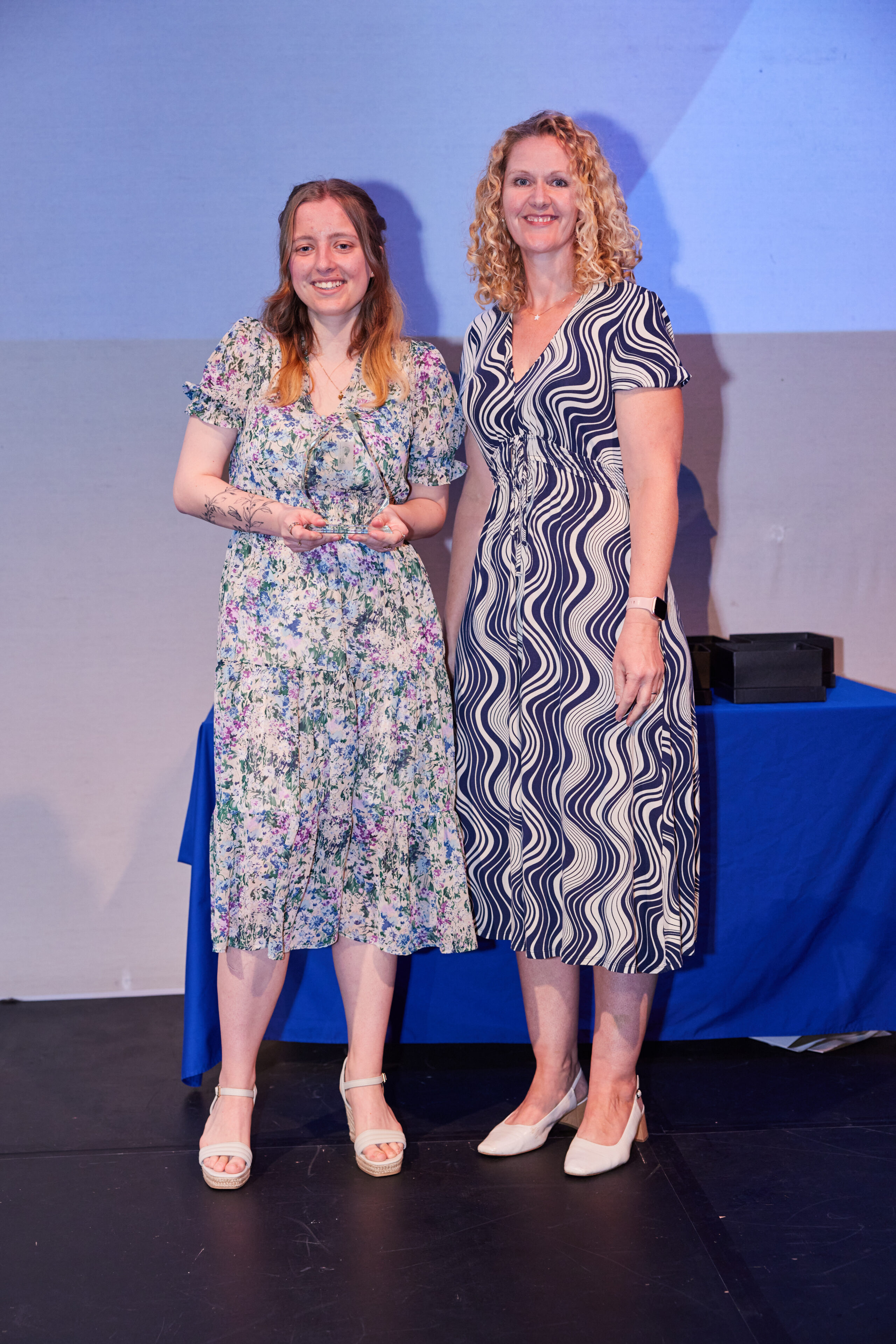
Jenny AshworthAmbassador, with a Youth Pride of Somerset winner 
Sharon WatermanTrustee 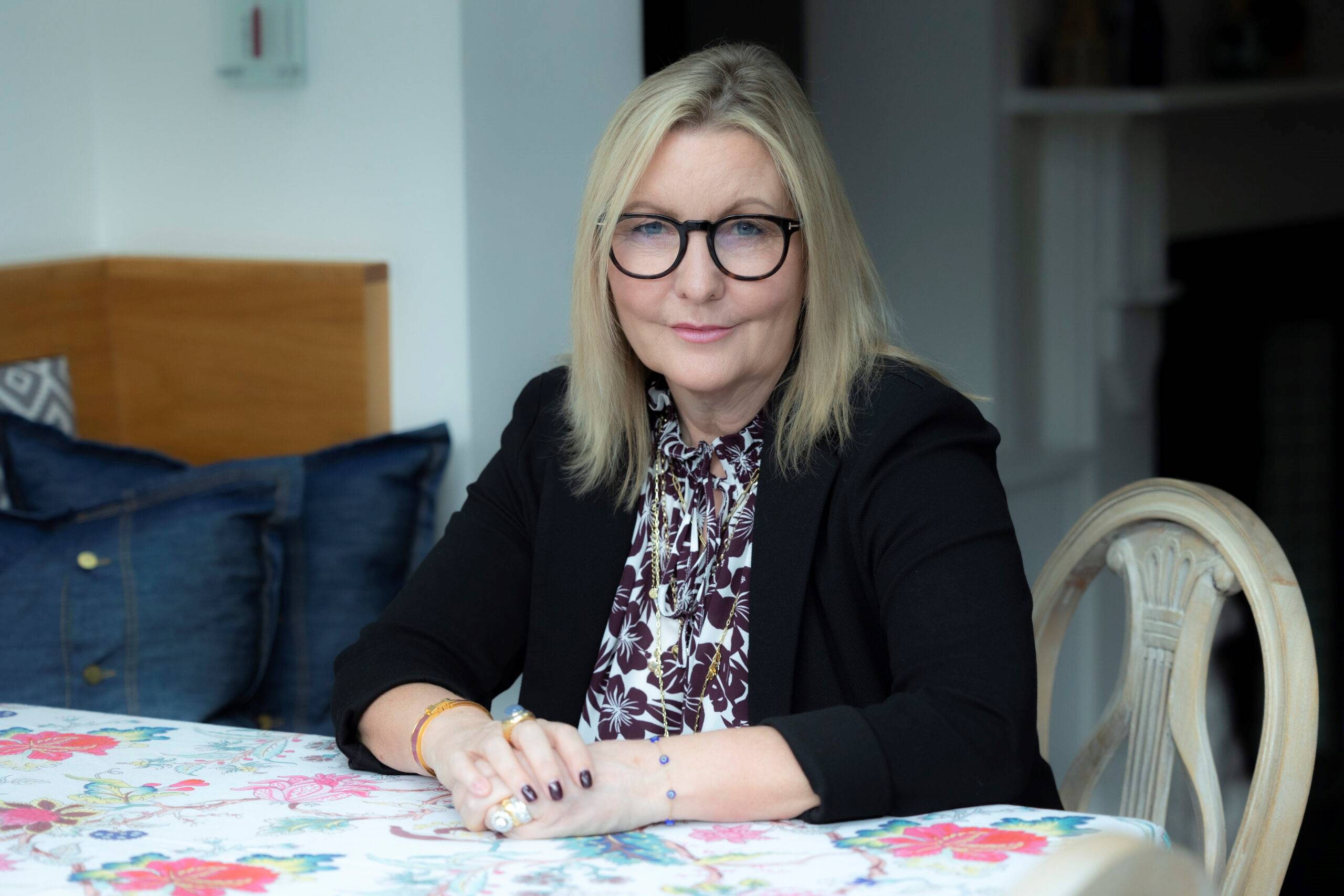
Kathryn PartridgeTrustee 
Andy O’BrienTrustee 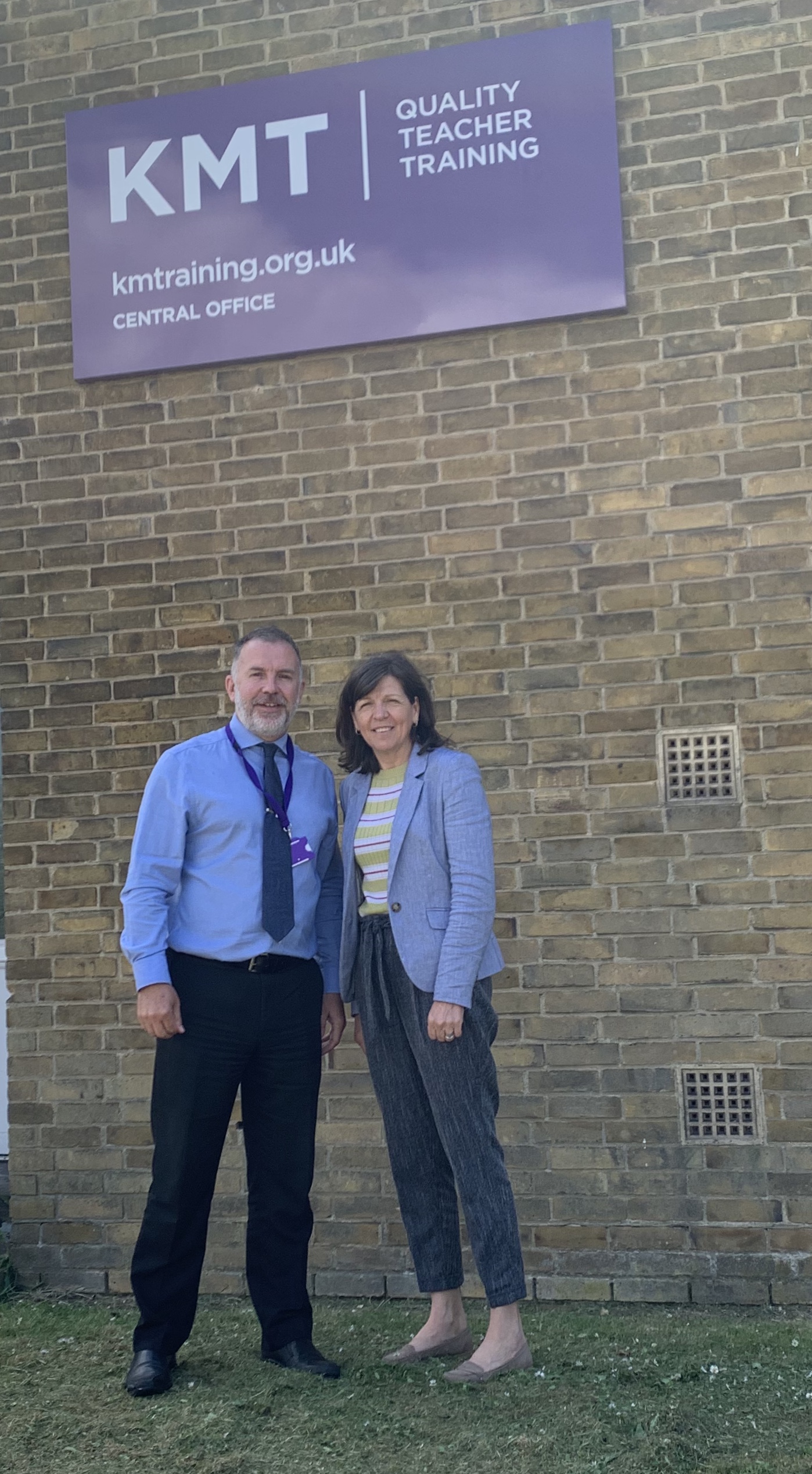
Stuart RussellFormer Director, KMT Teacher Training 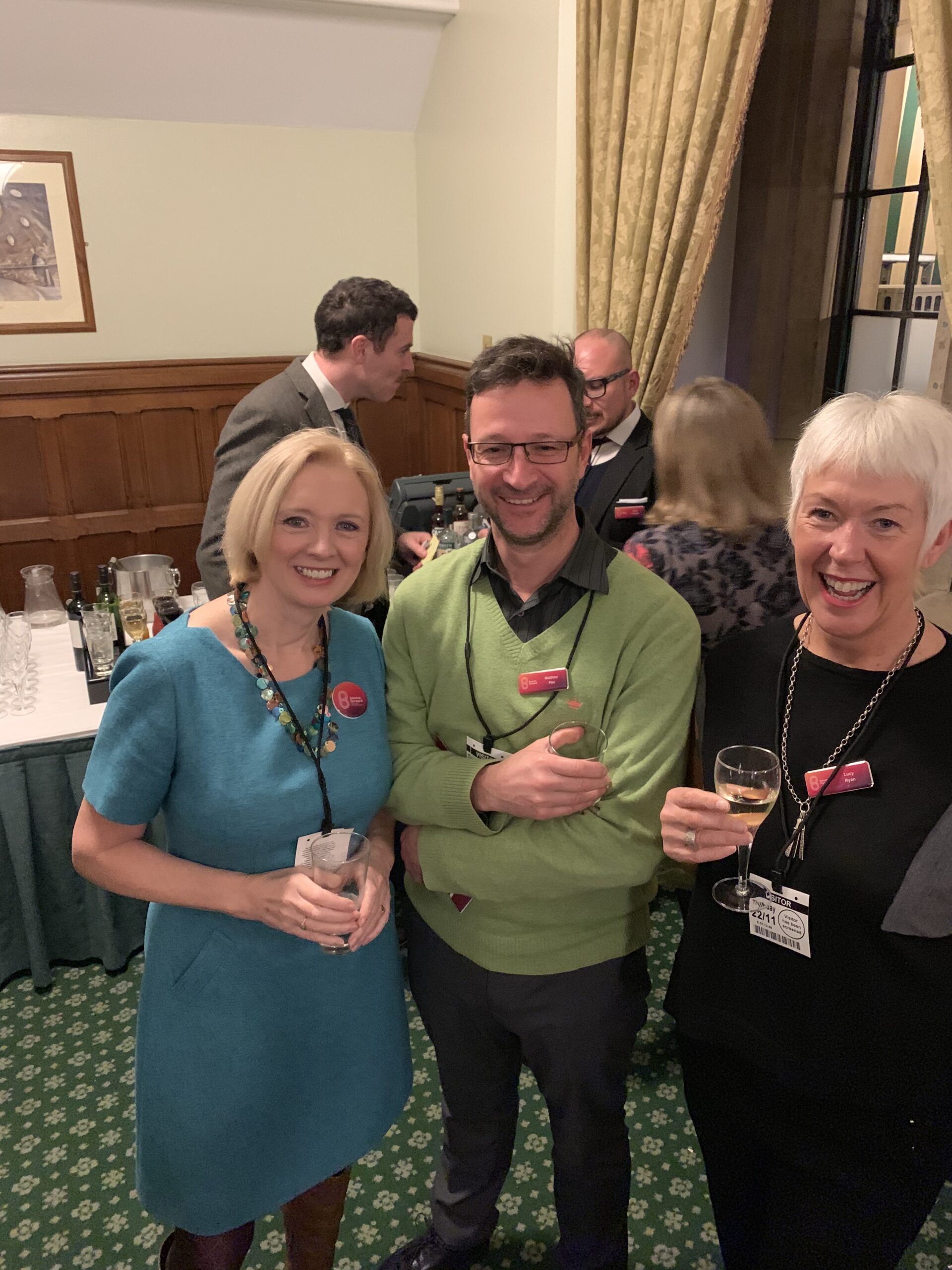
Lucy Ryan, Lesley Lyle and Matthew PennFormer Associate Trainers 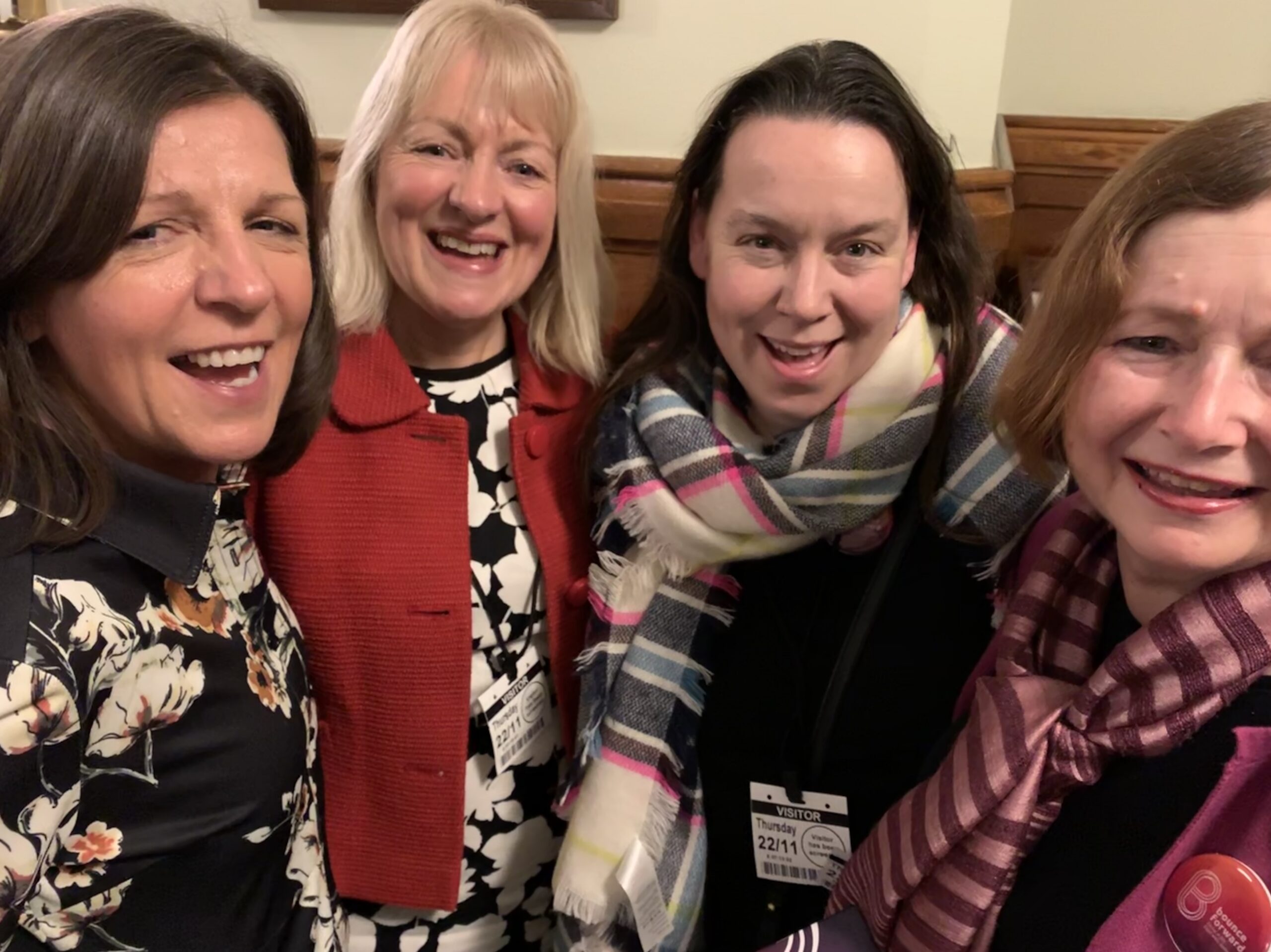
Hilary Kidd, Karen Cheney and Lindsay EdwardsLongdean School SLT and Hertfordshire County Council 
Voula TsofliasAmbassador & Co-Author of Raise Resilience 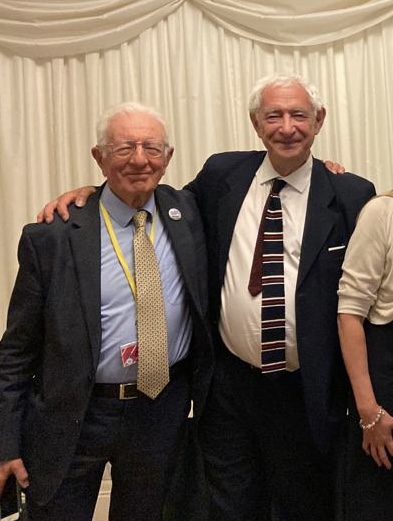
Lord David Triesman and Lord Richard Layard 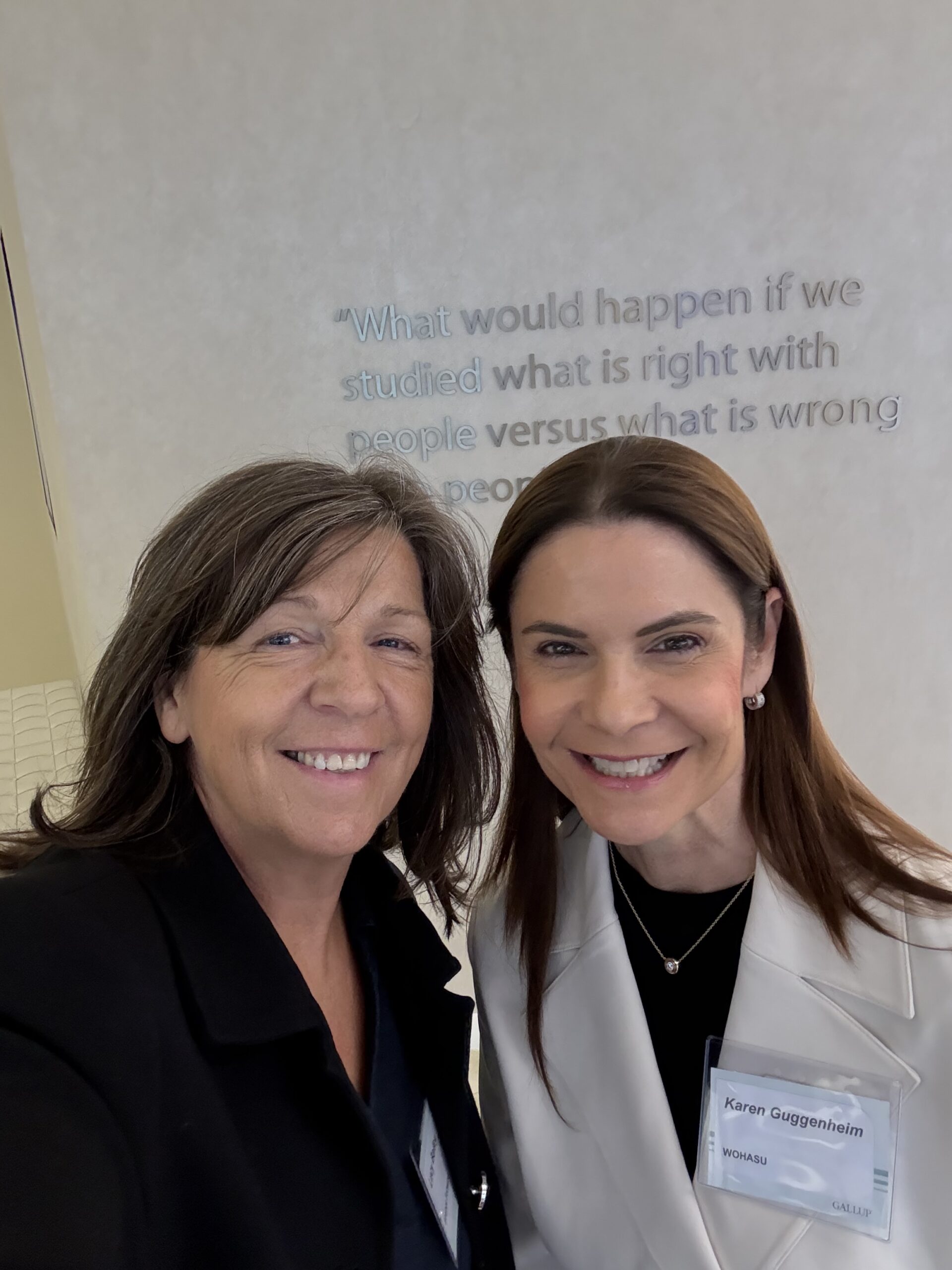
Karen GuggenheimFounder, WOHASU Wellbeing Foundation, World Happiness Summit 
Rob StevensonAmbassador, with a Pride of Somerset winner 
Shenel ShefikFormer Education Lead & Associate Trainer 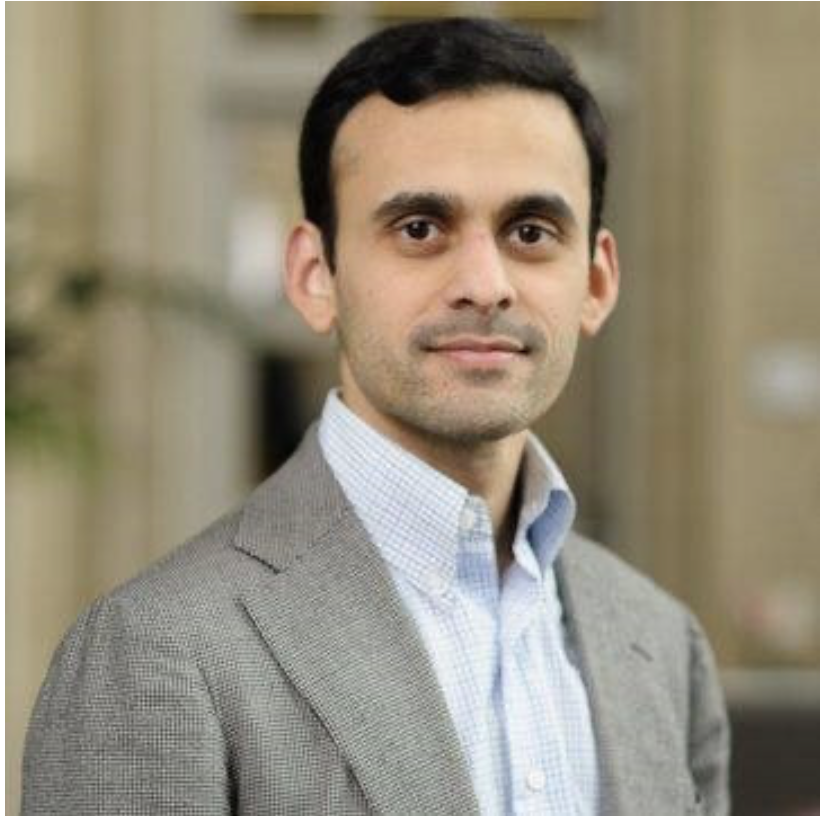
Anant JaniResearch Fellow & expert contributor to Physical Resilience 
Lucienne MillarAmbassador & Associate Trainer for Armed Forces 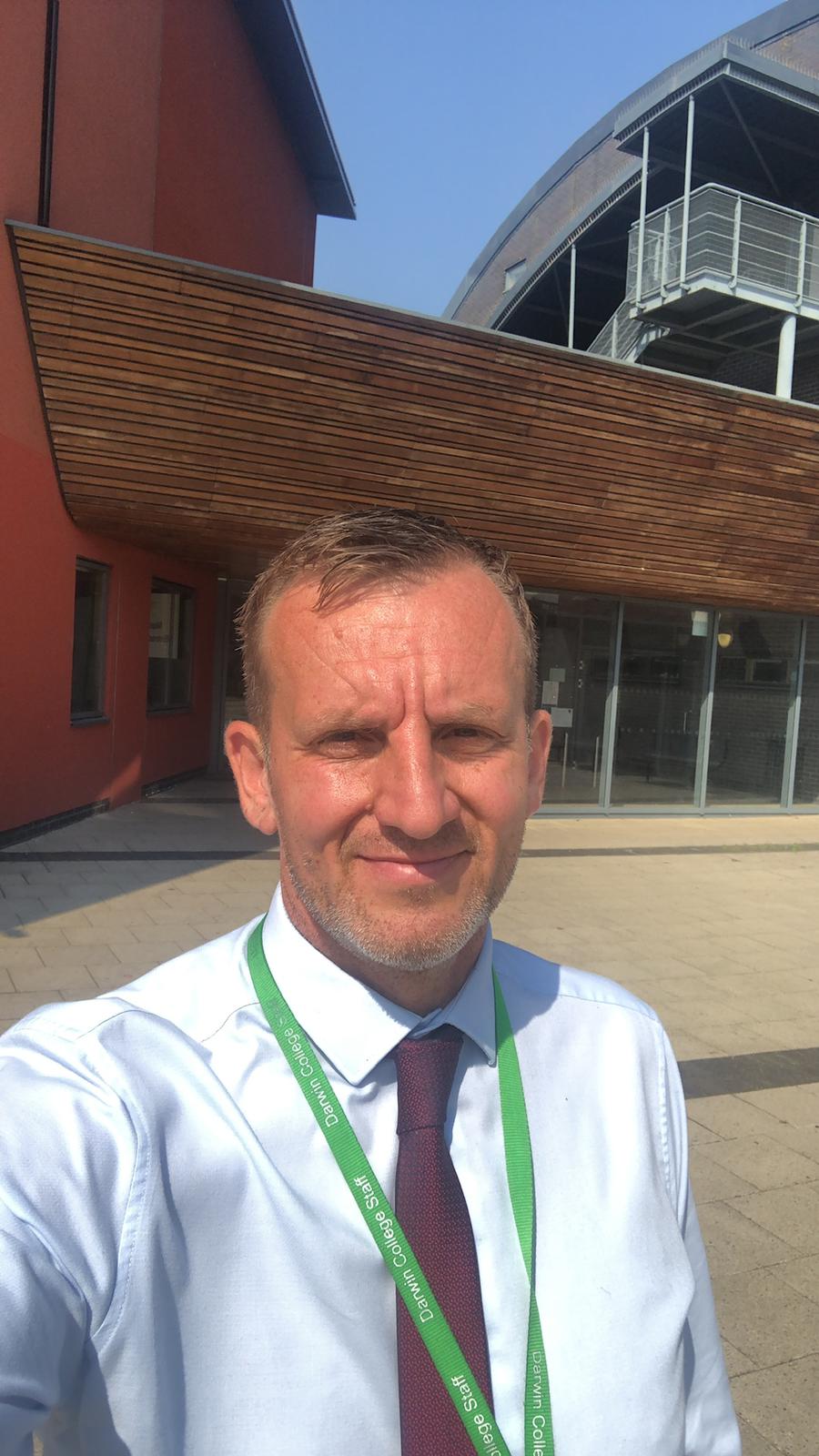
Stuart LindarsFormer Education Executive 
Chloe LowryAssociate Trainer 
Carlsberg Britvic Roadshow 
Diane LairdAssociate Trainer 
Viv VellaEarly Associate Trainer 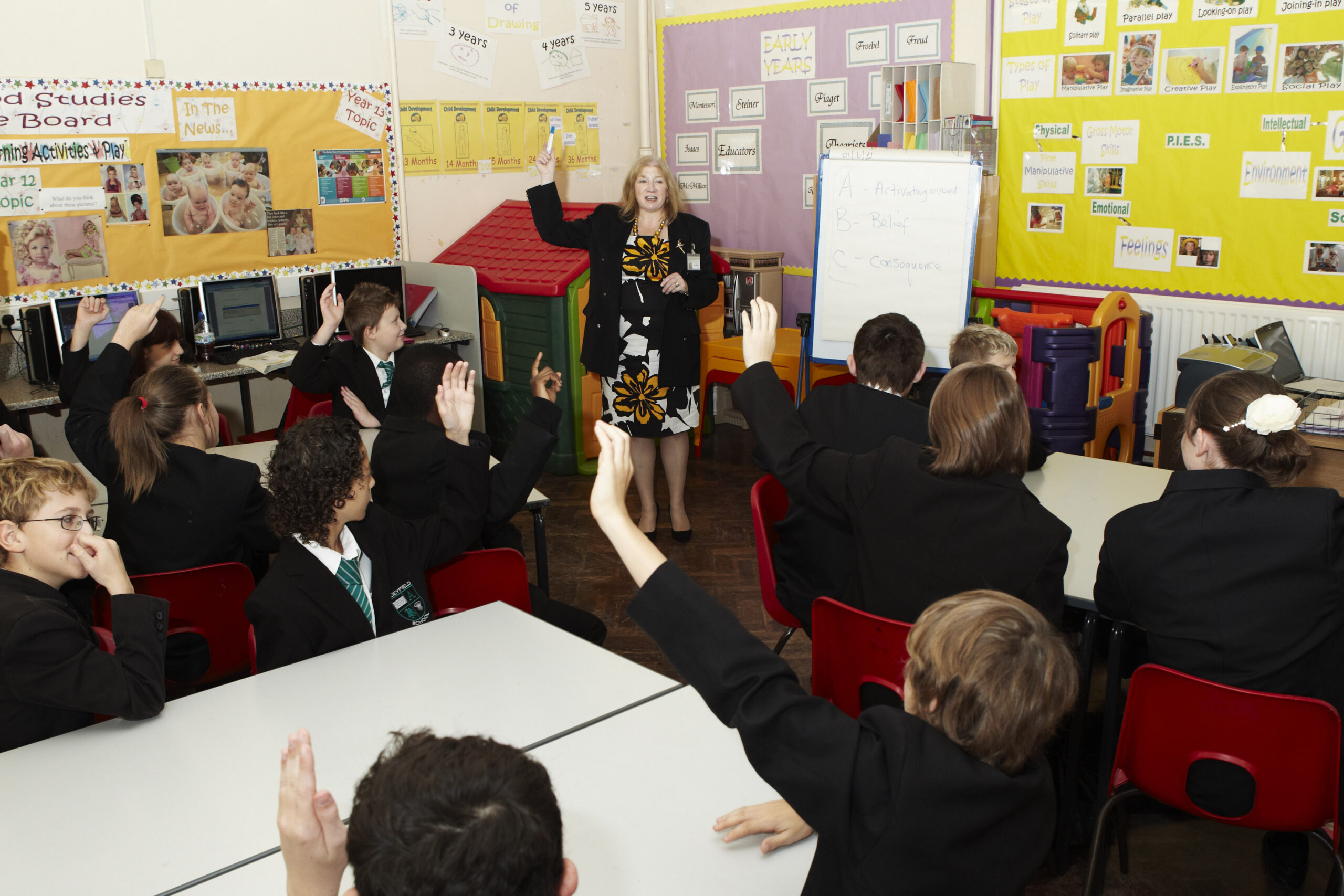
Pat CampFirst PRP Teacher & Associate Trainer 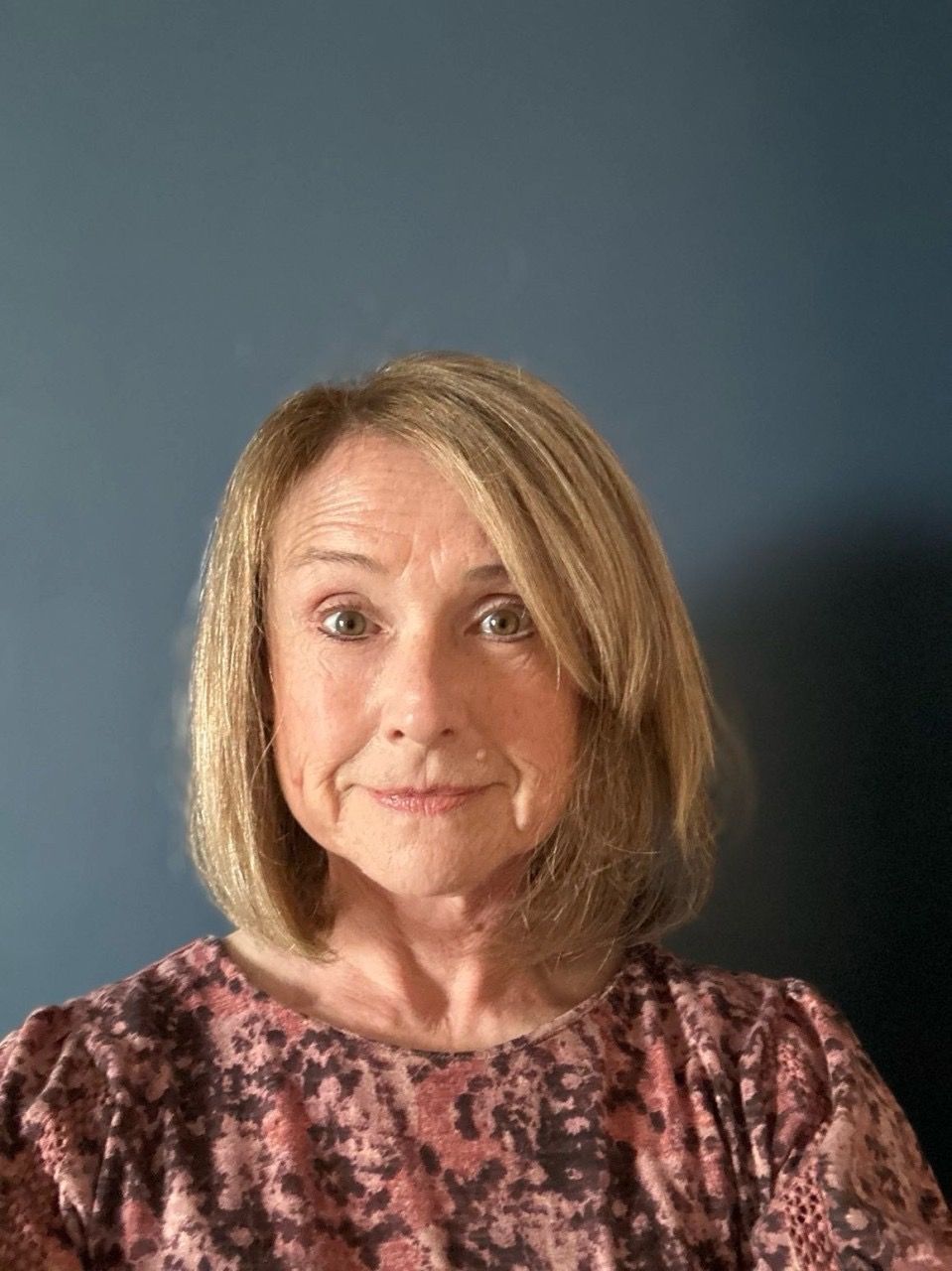
Claire FarrellFormer Associate Trainer 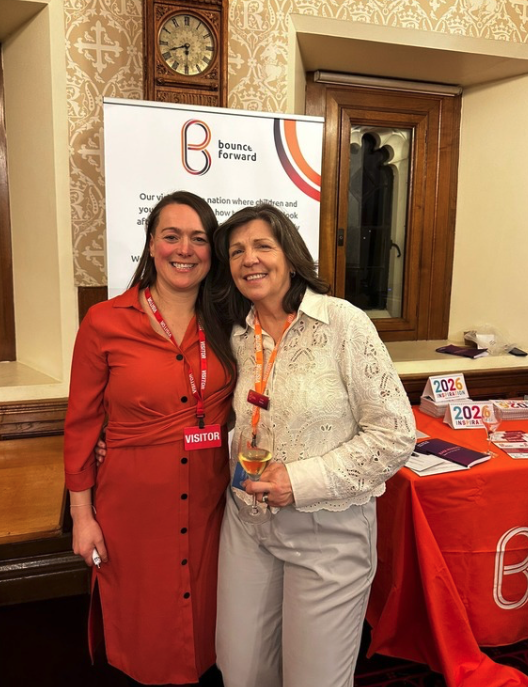
Natalie WilliamsMental Health in Education Manager, Oldham Council 
Shirley GeorgeAmbassador 
Wellbeing Club Dinnerhosting The Secretary of State for Education 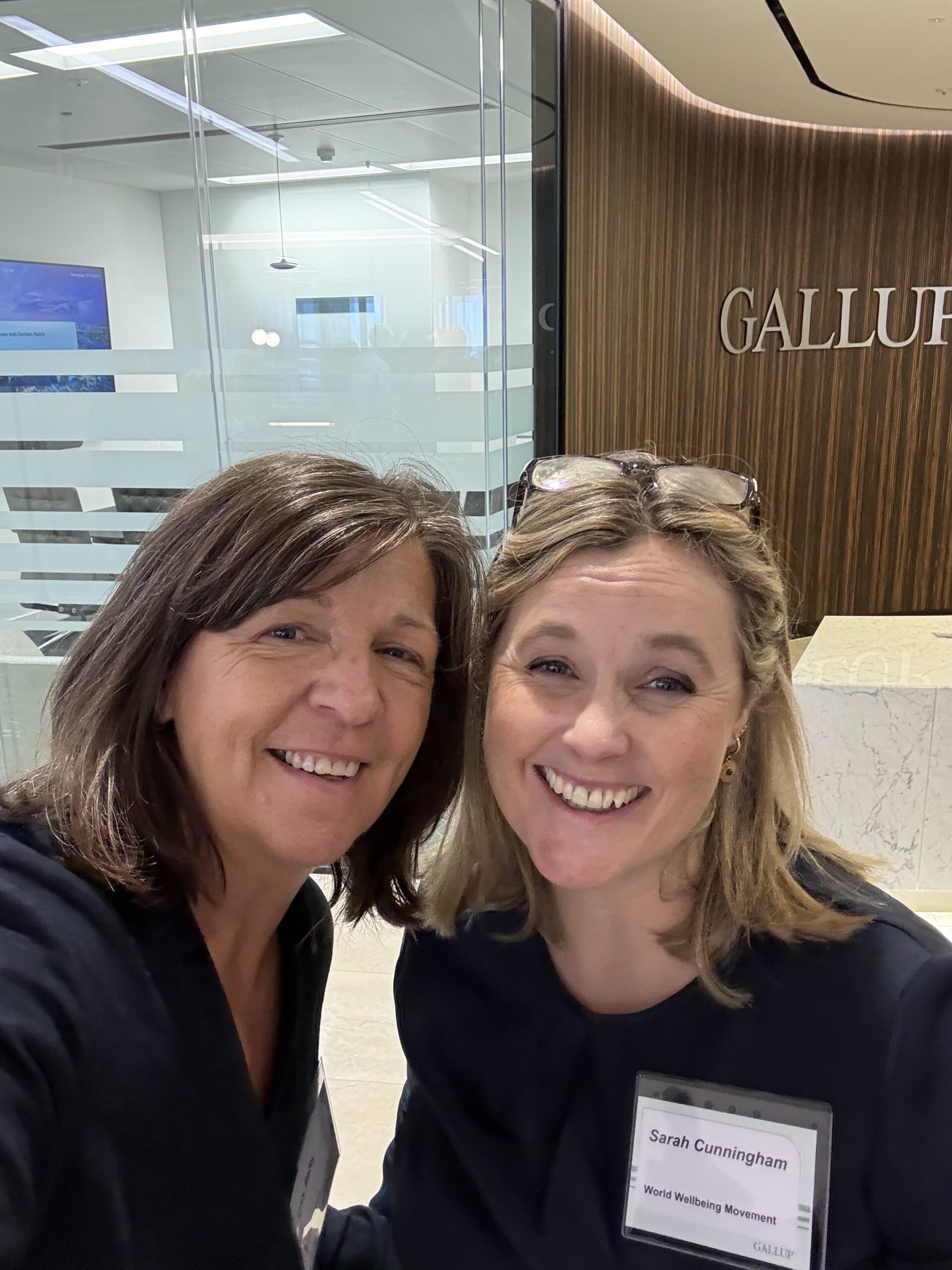
Sarah CunninghamChair, World Wellbeing Movement Expert group Dr Pooky KnightsmithAuthor, Mental Illness Investigated 
Strive and Big Change 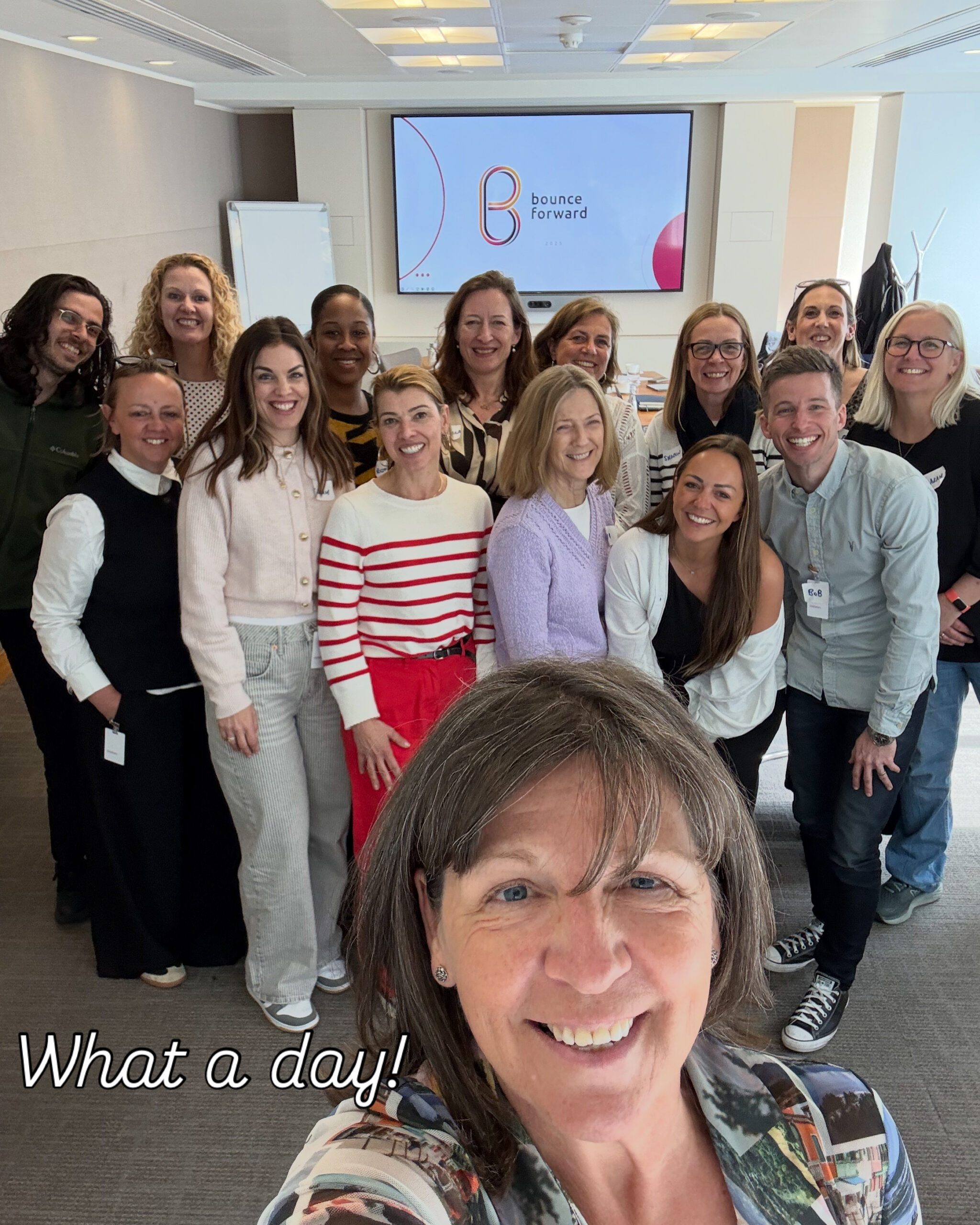
Extended Team 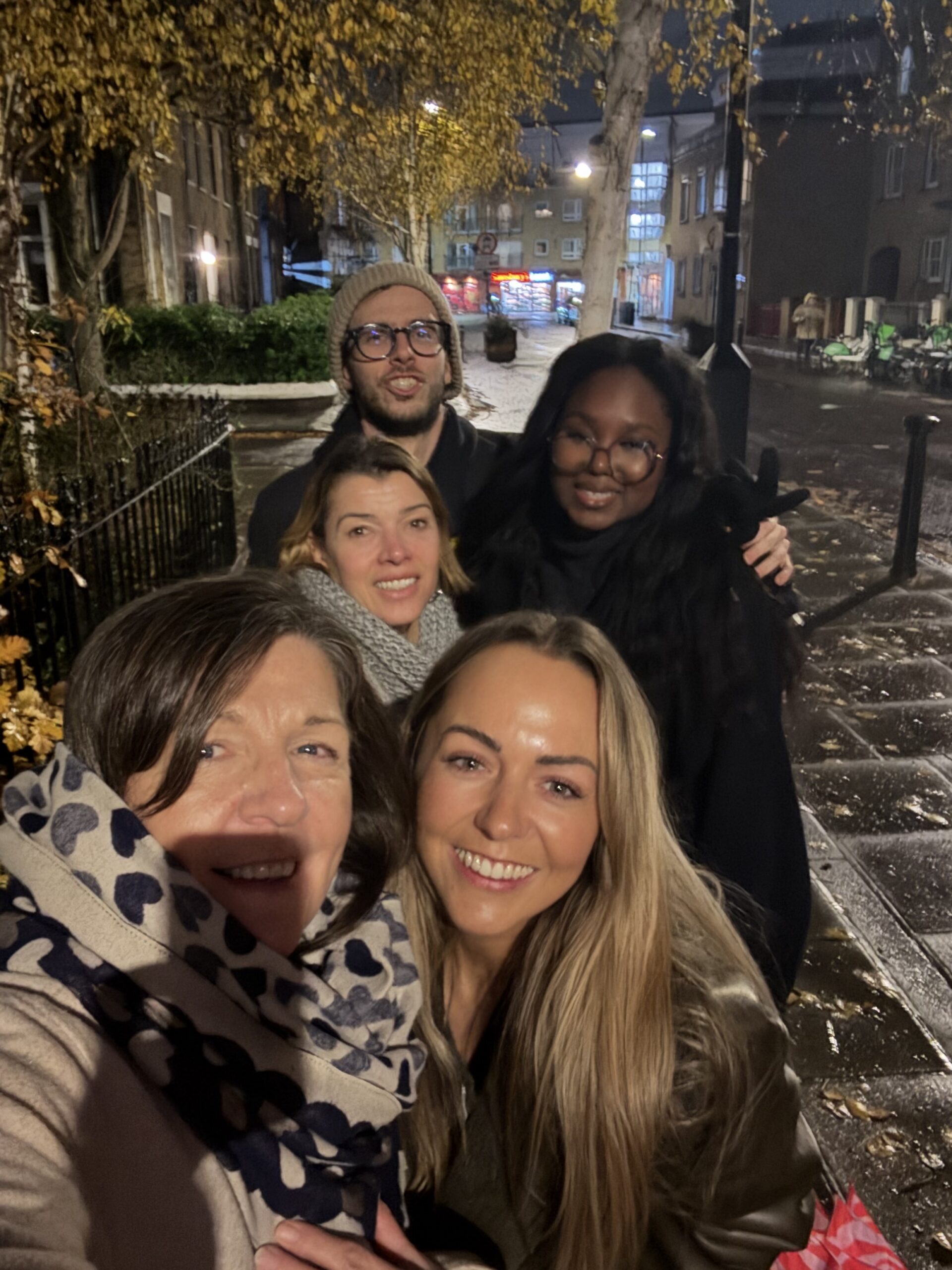
Rob, Appi, Daniela and Elisha 
Carlsberg Britvic Fundraisers 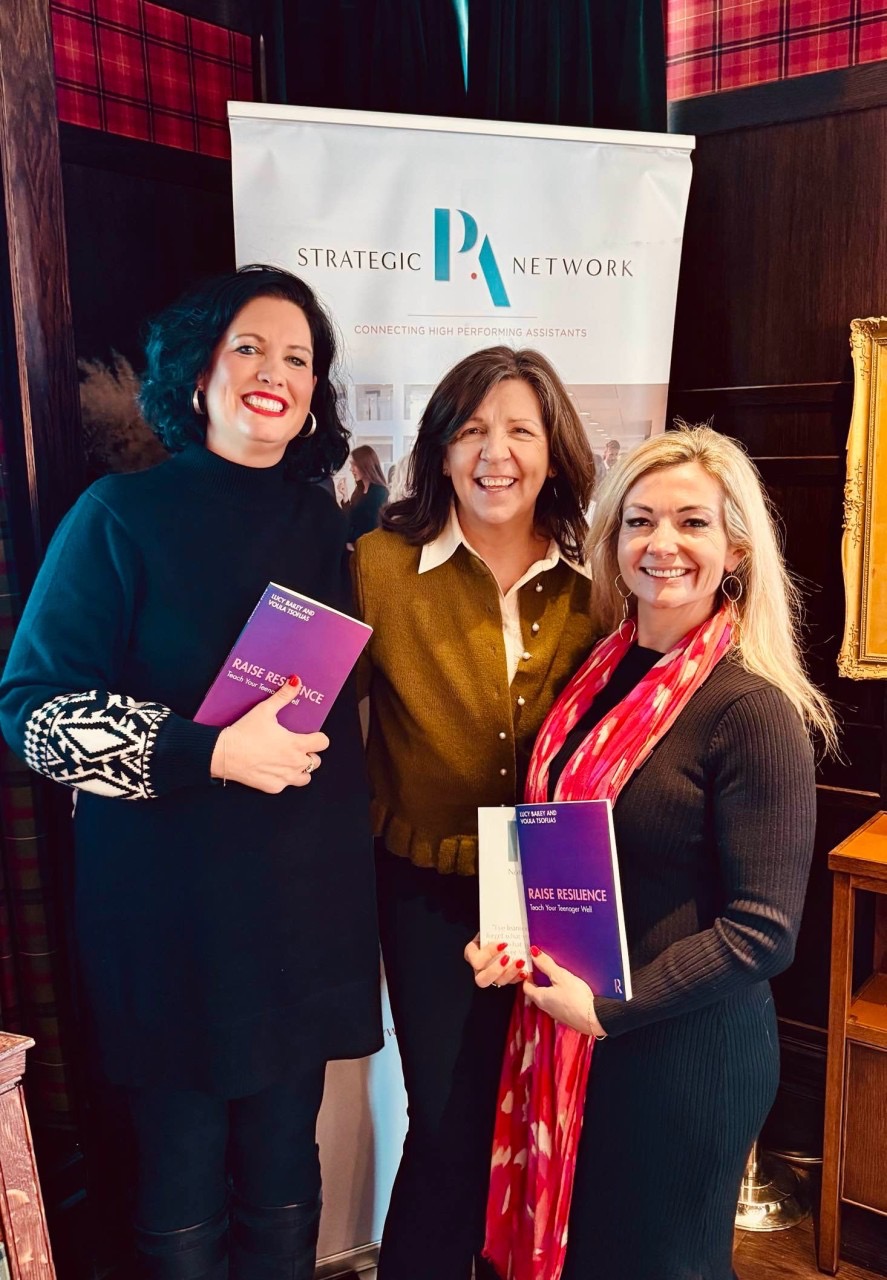
Sarah Howson and Marianne WhitlockStrategic PA Network 
Tom Cattermole Former Support Officer 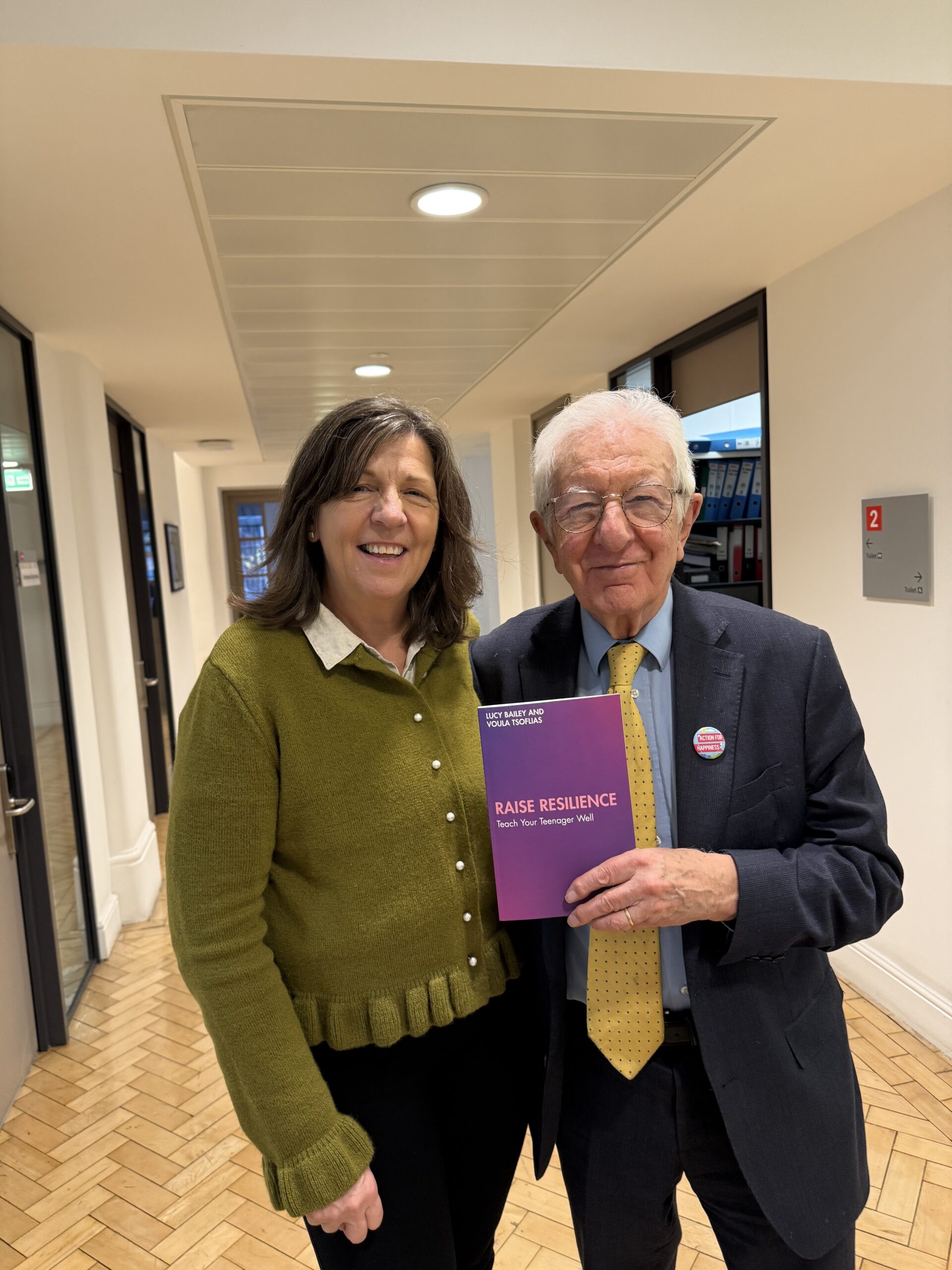
Lord Richard Layard and Lucy 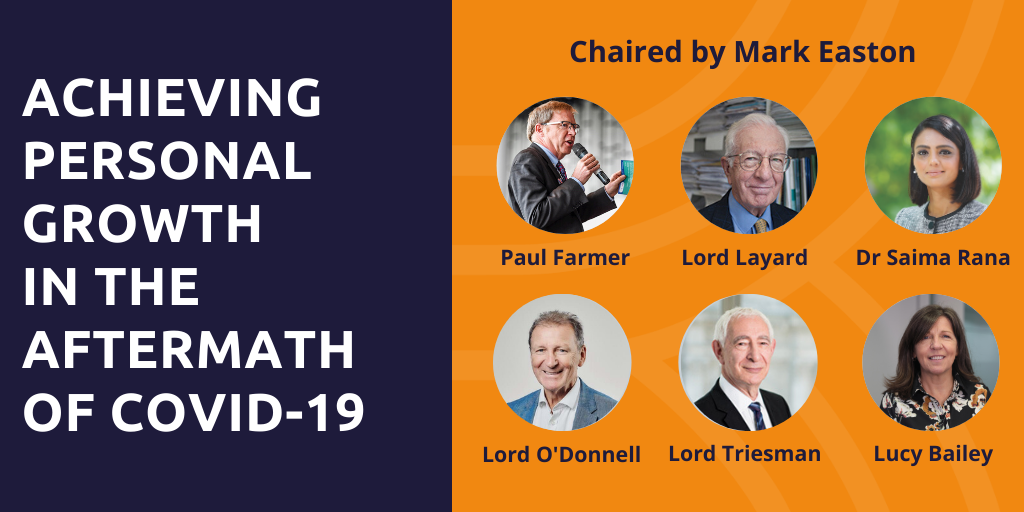
The Covid-19 Panel 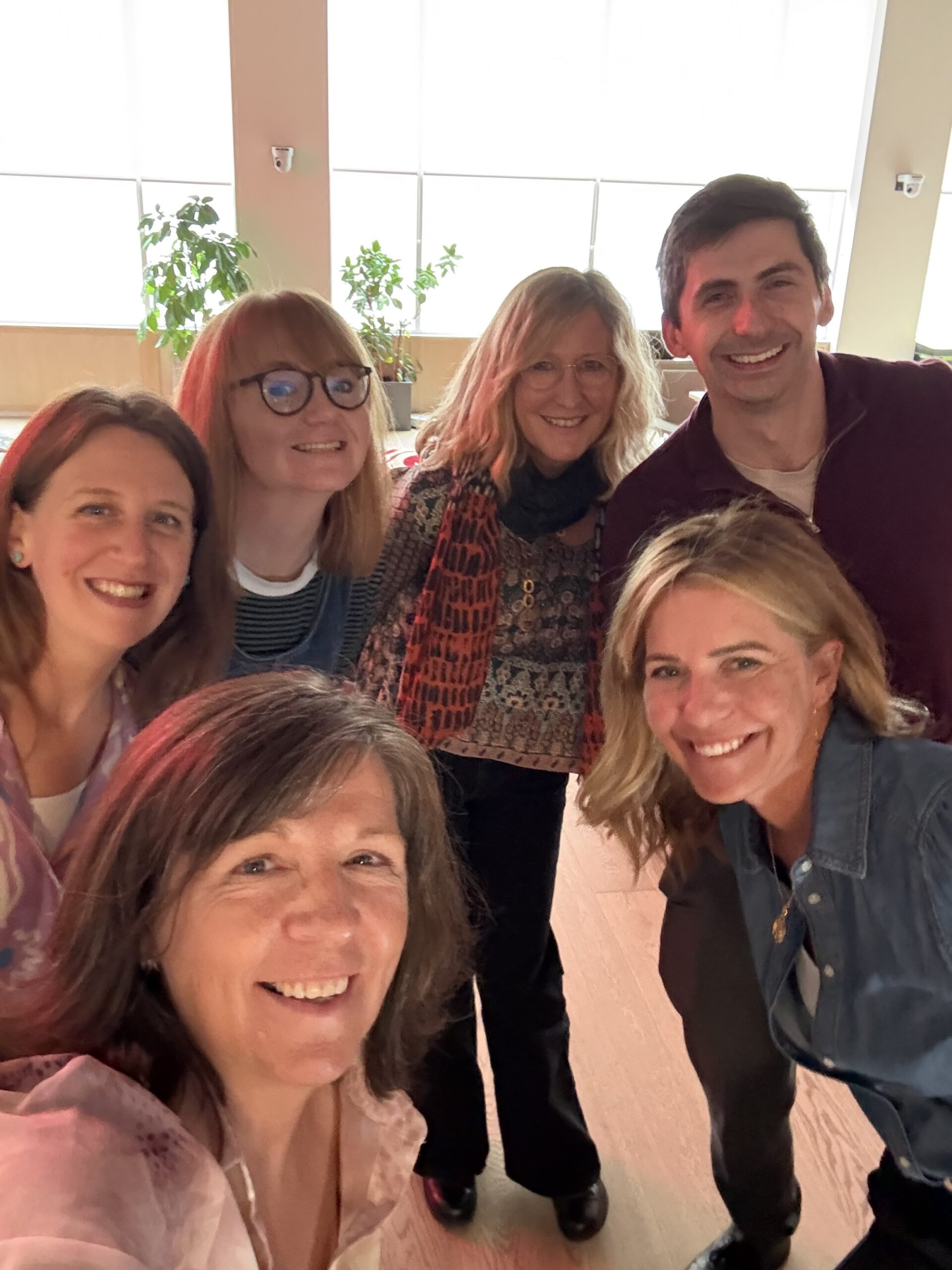
Big Change Community 
Kate Blakeley & Clare FleekersClick Communicate 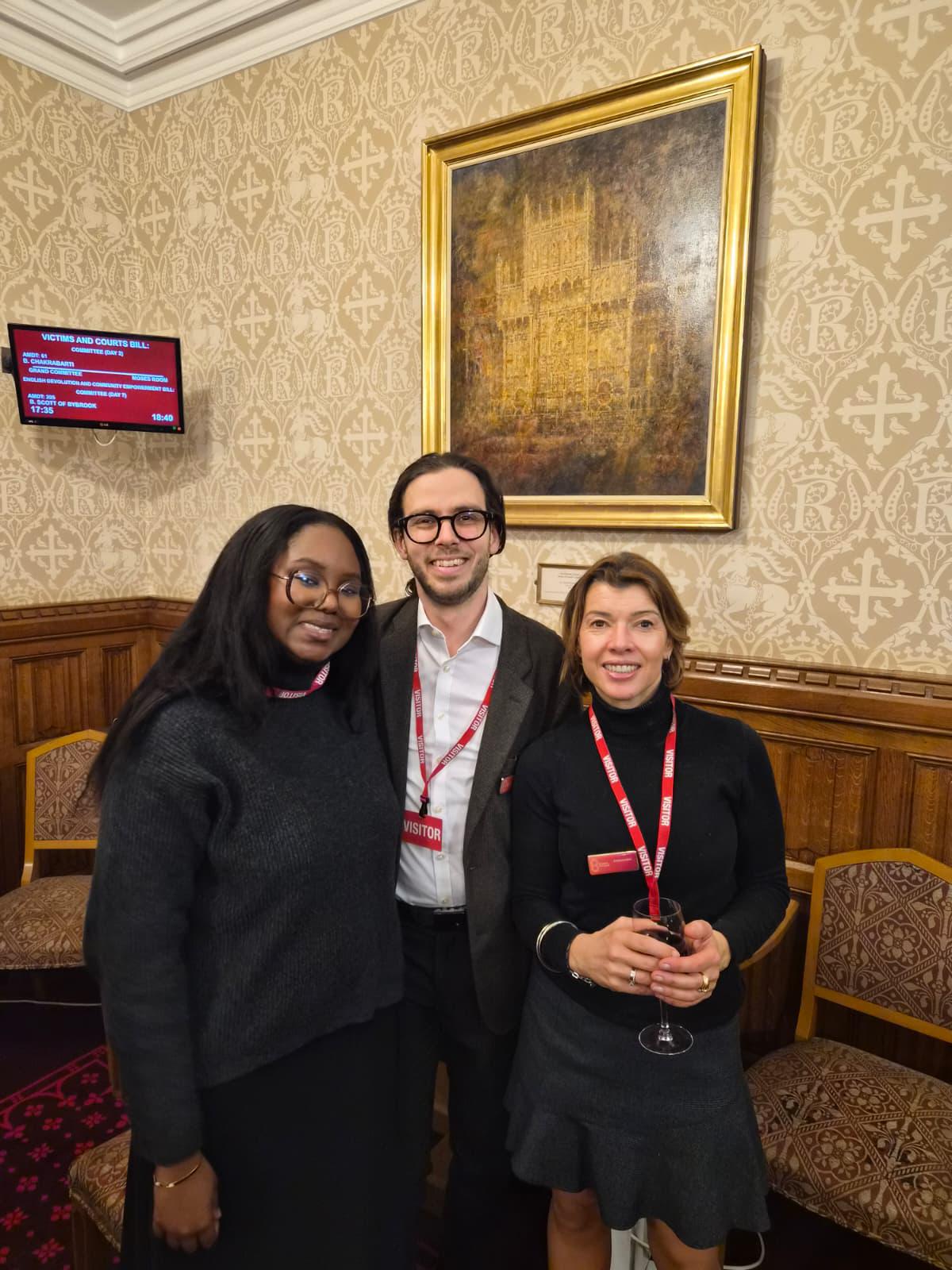
Rob, Daniela and AppiAmbassadors at House of Lords 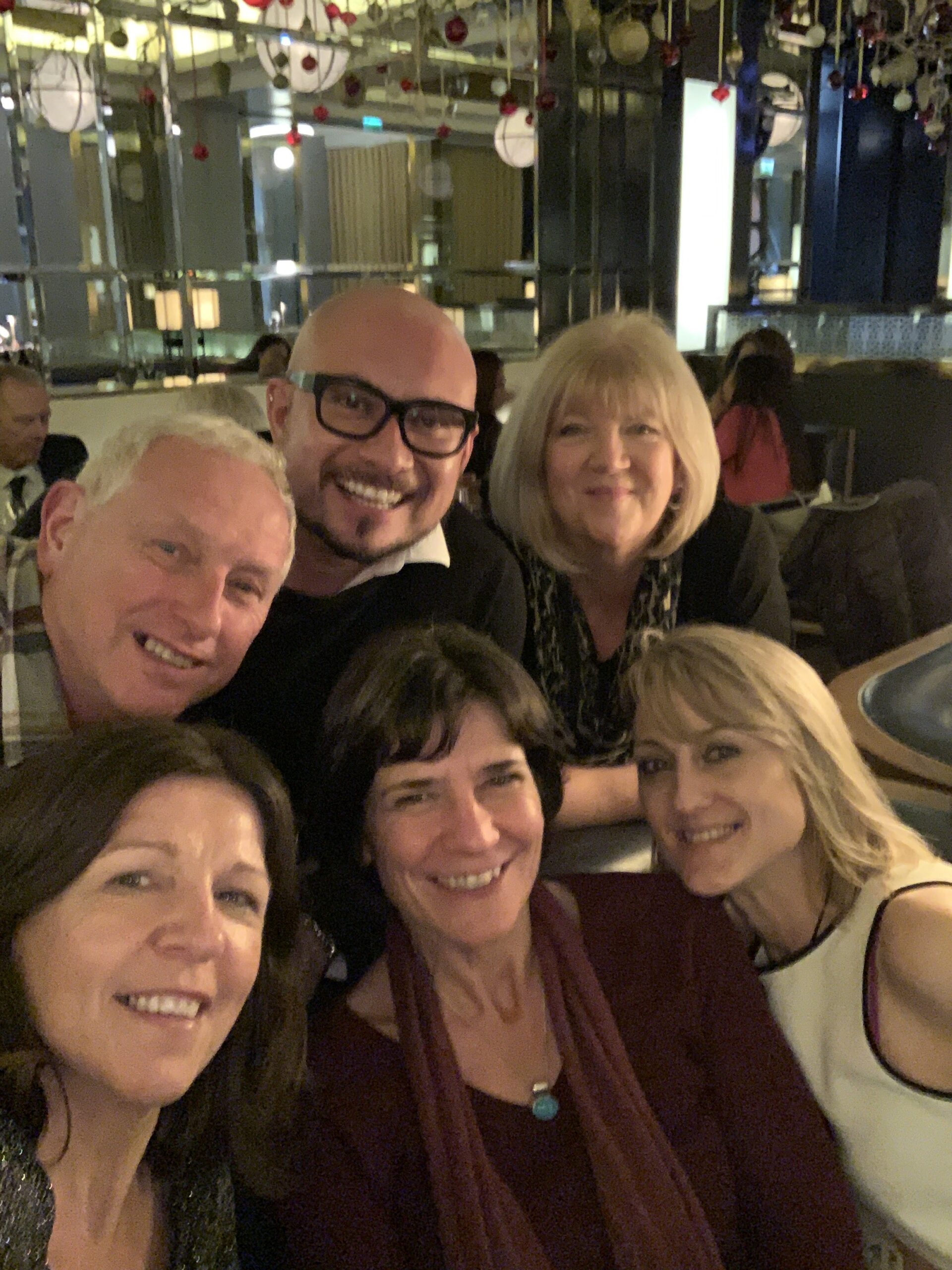
Steve, River, Dawn, Dr Julie Harris and Julie
The people who made it possible
A permanent thank you.
We could never capture every relationship that has mattered to this journey. These are just some of the many people who have helped us learn, grow and reach further. If we have missed you, please get in touch — this story belongs to many people.
See the acknowledgement roll
People who saw and worked with the possibility
Caroline Tapster, Lindsay Edwards, Andrew Simmons, Professor Jim McManus, Lord Richard Layard, The Young Foundation and Hertfordshire County Council. We’ve also had some incredible employees and associates including Dr Julie Harris, Julie Newbury, Louise Stokes, Matty Tilbrook, Claire Farrell, Dawn Smallwood, Stuart Lindars, Tom Cattermole, Shenel Shefik, Lee Newitt, Molly Arnold, River Ferreira, Steve Lily, Jack Hoad and Kayleigh Burr.
Extraordinary Contributors
Along the way we have been so fortunate to work with so many people including Professor Felicia Huppert, Sir Tim Brighouse, Sir Anthony Seldon, Lord James O’Shaughnessy, Dr John Coleman, Lord David Treisman, Lord Gus O’Donell, Karen Guggenheim, Berty Way, David Gregson, Geoff Mulgan, Emily Yeomans, Professor Alistair McGuire, Dr Grace Lordan, Ian Morris, Nancy Hey OBE, Sarah Cunningham, Richard Burnett, Joe Hayman, Anant Jani, Mark Easton, Jake Hayman, Jonathan Baggaley, Professor Daphna Oyserman, Leslee Udwin, Mary Rees, Lucy Emmerson. Each one has helped shaped our thinking.
Research shaped by relationships
Professor Felicia Huppert, Dr Grace Lordan, Dr Amy Challen, Dr Richard Murphy, Dr Julie Harris, Professor Alistair McGuire and research partners at the London School of Economics, NIESR, Bedfordshire, Bristol, Hertfordshire and UCL.
Building UK capacity
Our training team began with the guidance and leadership of Martin Seligman's team at the University of Pennsylvania — Karen Reivich, Peter Schulman and the wider team, including Eleanor Chin, Randal Ernst and Denise Quinlan, to name a few. In the UK we were guided by Emma Judge, the first UK-based University of Pennsylvania lead trainer, who shaped the training model and led the training here. That saw our UK-based training team emerge: Pat Camp, Yvonne Snow, Steve Lily, Matthew Penn, Viv Vella, Denise Chatterton, Voula Tsoflias, Diane Laird, Jill Tonks, Lucy Ryan, Dan Collinson, Lesley Lyle, Fiona Tryon, Heather Johnston, Pete Mann, Denise Chatterton, Janice Hennessey, Lesley Cox, Lindsay Harding, Emma Tetley, Emma Munter, Helena Johnasson, Kristova Rueda, Miriam Akhtar and so many more.
The schools who said yes
Rhodri Bryant (Longdean), Gary Lewis (Kings Langley), the Hemel Hempstead secondary heads, and teachers across Hertfordshire, Manchester and South Tyneside — including Hillary Kidd, Karen Cheney, Pat Camp, Graham Cunningham, Kim Bristow and Yvonne Snow. The first schools to say yes to taking part in Healthy Minds; The Leigh Academy, Chancellors, Hearne Bay, Kingswood, Whitefield; 36 schools in total including St Lukes Special school. To all the schools that have stayed with us on the journey including, Carlton le Willows Academy, Monk’s Walk, Manor School, Cornerstone, Northampton Internal Academy and Chancellors.
The people who sustained the work
Every past and present trustee — including Sharon Waterman, with us since the beginning, Kathryn Partridge and Andy O'Brien — people who have shown support. People who have given generously their time and energy their leadership their friendship their connection. Amy Bradshaw, Rob Stevens, Jenny Ashworth, Daniela Sarti, Bob Wilkinson, Arabella Turner, Martin Bellamy, Claire Pearce, Sarah Munday, Marie Pierre Burgess, Caroline Bishop, Jo Owen, Glen Christie, Voula Tsoflias, Matt Kingdom, Davnet Doran, Russel Hobby, Appi Mustapha, Cookie Twigger, Lee Cook, Jill Huges, Kate Blakely, Shirley George, Julie Harris, Sarah Howson, Marianne Whitlock, Gary Redfeather, Anna Inama, Patrick Quirke, Chloe Lowry, Roxanne Hunte, Lucienne Miller, Shane O'Connor, Sarah Chamerberlain.
Opening doors and creating opportunities
The Elliot Simmons Charitable Trust, Education Endowment Foundation, Big Change, Carlsberg Britvic, Harry Kane Foundation, KJ Smith, Accenture, and the Strategic PA Network.With grant funding from Hertfordshire, Oldham, Kent, Northamptonshire, North Yorkshire, councils, the Armed Forces Covenant Fund Trust, Aviva Community Fund, the Arnold Clark Foundation, Sussex Police to name a few.
Still carrying it forward
Elisha Hamilton and today's team Andy O’Brien, Bob Wilkinson, Amy Bradshaw, Katie Cunningham, Tom Turner, Laura Smith, Lisa Sammuels, Fay Crowther, Phil Lewis, those who continue to contribute, to support & volunteer, our associates and — current partners, BounceTogether, PGL Beyond and Healthy Minds for Parent, thank you. You truly mean the world.
What the evidence taught us
Twenty years of research. Still asking better questions.
Good research doesn't simply confirm what we already believe. It challenges us and helps us ask better questions.
Development and learning don't compete.
Healthy Minds showed positive effects on general health, physical health, life satisfaction and externalising behaviour — without adversely affecting academic attainment.
The impact travels into family life.
In one early evaluation, 74% of parents felt more resilient, and 79% of those completing pre- and post-measures recorded improved wellbeing.
Strengthen the adult and the learning travels.
One Anxiety Unravelled project reached 569 military parents and indirectly supported more than 1,300 children. Trainee teachers use the skills in their own responses and classrooms.
These three words are deliberately simple. The science beneath them is not.
In their words
The voices that shaped our journey.
Reflections from young people, teachers, schools and others who value Bounce Forward’s work.
-
In a time when young people and children are facing more challenges in the world, Bounce Forward has offered us a solution to support parents help their children achieve. We started working with them over covid and have continued ever since. Parents have been overwhelmingly positive with flexibility of being on line reaches everyone. After 3 years of using Bounce forward we still sell out every course with parents coming back for repeat access. Working with Bounce Forward as an organisation is a pleasure as feedback provided, bookings arranged, and publicity provided, all in a timely and efficient manor.
-
As a school we know that students can only perform academically if they are in a stable place emotionally and have the resilience to cope with the knocks of life. We believe that education is about so much more than outcomes at GCSE and we are therefore delighted to be a Bounce Forward / Harry Kane Foundation lead launch school and to get the chance to use Healthy Minds resources to continue to upskill our staff and to develop the resilience and wellbeing of our whole school community.
-
I was scared and nervous of going to secondary school. I had some friends that I was going with, but they didn't seem to be nervous. I spent a lot of time saying to my mum that I didn't want to go and then would cry a lot when I was there. I didn't want to fail and thought I was always going to get things wrong. I guess I've been used to being at home a lot and it seems to be the only thing I think of and I can't find a way to stop it. Those lessons helped me see that other people felt the same as me and my teacher was so kind.
-
I have had a meaningful conversation with my son regarding the pros and cons of mobile phones. It gave me the confidence to have the discussion rather than just change the subject as previously done, due to my mixed emotions regarding the best age at which my son should get his first mobile phone. This course has really helped with the conversation.
-
Resilience and emotional wellbeing have been demonstrated to be teachable skills. The Bounce Forward skills are worth investing in across the lifecycle given their proven relationship with health, wealth and happiness.
-
I can’t lieve that 20 years have passed since the Local Wellbeing Project. All those trips to London to meet with the Young Foundation and the other authorities. It was a great privilege to be involved in developing something so important. I really believe that the current climate is right for further expansion of the wider programme you are offering as, at last, there is some public recognition that young people have been let down. I really enjoyed reading about the developments and the growth journey. I know you will go from strength to strength.
-
We know that our mind enables thoughts, memory, movement, and emotions by complex functions. Developing and maintaining healthy minds throughout our learning journey is critical in meeting the increasing challenges educators and learners face. It is vital that we understand what helps our learners become more resilient as we live well together. We are proud to partner with Bounce Forward as a Harry Kane Lead School to realise this essential goal.
-
Bounce Forward has helped my year group understand each other's feelings a lot better. We now look at situations in-depth rather than just how they seem on the surface. It has made me a calmer person. I don't catastrophise as much anymore. I was snappy to make decisions in the past, but now I slow down and assess situations.
-
Young carers have a lot to deal with. Our job as teachers is try and help them focus whilst in school, to help them get their grades so they can make something of themselves. Healthy Minds lessons give us the time to really get to know our students, and for them to get to know each other. The moment they realise they are not the only person dealing with their situations is priceless and I hope something they take with them beyond school.
-
At our school, we’re always looking for ways to stay ahead of the curve when it comes to the prevention of mental ill health, especially with our younger students. Healthy Minds has been a game-changer for our Year 7 and 8 students - it gives us a structured, evidence based way to build their mental resilience. We’re incredibly grateful to Bounce Forward for the support and resources they’ve provided to help us embed the programme successfully.
-
Definitely a positive experience and has built my confidence in tackling difficult conversations and situations with my children. It is a first step and has set me thinking about all the issues that come to play in relationships. I felt I needed more time to absorb what I was hearing and will probably be working through it all more slowly after Christmas! I need to 'put on my oxygen mask before trying to help others'.
-
Healthy Minds will become an integral part of our Personal Development programme as we build our students' confidence, resilience and knowledge so that they can keep themselves mentally healthy. The Bounce Forward programme will help to facilitate the development of skills and qualities that will enable our students to become independent and thrive in society.
-
Manor School is proud to announce we have achieved the Bounce Forward Healthy Minds Kitemark. We are the first Harry Kane Lead school to receive the award. As a Trust we focus a lot of attention on psychological fitness and wellbeing for both children and staff - it has been an important part of our whole Trust strategy for six years. It is great to receive this recognition especially as mental health and wellbeing has been something we as a family of schools have been championing for a long time now.
-
What we teach young people matters, but so does how we prepare them to live their lives. Research shows that schools and teachers have a lasting influence on wellbeing, far beyond the school years. That is why the regular teaching of Healthy Minds is so important. These are skills that deserve to be learned, practised and strengthened over time, just like any other subject. By making Healthy Minds an enduring part of school life, we are investing not only in pupils' education today, but in their wellbeing for years to come.
-
It's been a joy to walk alongside and learn from Lucy and the Bounce Forward team for almost a decade. In that time we've seen their work grow, expand and constantly evolve to meet the complex and ever changing needs of young people and families. They've led the way as champions of psychological fitness and have impacted countless lives. We can't wait to see what they achieve next.
-
It's different for each person because I enjoyed everything I learned. When I sit in one of those lessons, I really like ‘connect’ and I switch on a different part of my brain. I know it sounds weird but I don't think about school, I think about life as a whole and you learn different things, but every single thing that you learn in each topic is very real, it's personal.
-
The psychological and emotional skills taught in the Bounce Forward programme are vital for the wellbeing of young people, can help prevent ill-health and enhance learning. They are also vital life skills for happy, fulfilled future lives.
-
I've had children in my class that haven't been able to pick up a pen but now they come into my class and talk to me, interacting with me like a human and with confidence. Sometimes the most important progress isn't measured by what a child writes on a page. It's in the confidence to speak, the trust to connect, the willingness to participate and the growing belief that they have something worth contributing. This is what teaching this can make possible. Not simply learning skills, but developing the confidence and capacity to use them in everyday life.
-
It has been hugely rewarding to work with Bounce Forward over many years. We have shared ideas and been able to translate research into real-world initiatives. I am so glad that my knowledge of adolescence has contributed to the work of this wonderful organisation. It has been a privilege to share the journey and to assist in promoting best practice in relation to well-being in young people.
-
The Healthy Minds package comes with planned lessons and high-quality resources to support the teaching of a range of current and very necessary units. This is especially important for our students who have significant needs in terms of cognition and learning and face added challenges in and beyond school. The units are broken down into formats that are user friendly, helping staff with their planning and delivery. We are looking forward to launching this with all year groups in the next academic year.
-
It's been a privilege to watch Bounce Forward Healthy Minds grow and reach more and more young people. Its approach is evidence-led, widely-referenced with the capacity to make a difference to more young people as it continues to expand and develop.
-
I thought the session was excellent. It was progressive, uplifting and positive. I particularly liked the ABC content. This is because it helped me understand that belief can have a big impact on a consequence, and that we shouldn't always assume a consequence based on an action that we've done before. The session was very insightful and didn't ignore the realities of teacher training and how at times it can be difficult. The session gave simple but effective techniques to think about when having a negative moment.
-
At The Radclyffe School we believe wellbeing lies at the heart of our students going on to succeed, both in school and in the community. All students have individual needs, and with us valuing the importance of embedding the Healthy Minds curriculum into our school day, this allows students to develop their emotional resilience and self efficiency. The Healthy Minds Kite Mark Award has allowed us to ensure that a high-quality curriculum is in place to engage learners and enable them to thrive.” _
-
Great course and so grateful this was provided to military families free of charge. The stresses that our children experience are significant and this support is so needed. Genuinely has made a real difference to our lives. The course provides functional ideas of things to do to support your children and provides a wealth of resources. I feel that many of the things I have learned are having a positive impact on my ability to support people outside my family as well.
-
It was genuinely some of the best training my team have been on all year. We met as a group again on Friday to plan how we will put it into action. At Corby Sixth Form, we will be running it in term 2 as a 5 week program for all students. Our intention is to certify it internally for our students to earn recognition for the resilience. We are then looking to create a refresher course in the year 2 of A levels at the same time as they wind up to the big January mocks.
-
The children were fascinated by the idea that our brain sometimes works inefficiently, it notices unusual things and relies on previous experience, and this can prevent us from reacting to situations. We think in patterns, and one of the tools that were offered during the training is very helpful in changing our Gremlin's thoughts (WOBbLe), and therefore changing the behavior that would be most effective for us.
-
Bounce Forward provided an inspiring, high energy day that spoke to the needs of a group of 120+ staff at our Trust. The feedback was overwhelmingly positive. Our staff really valued Lucy's accessible and engaging delivery, the relevant and challenging content, and the confidence she gave us as a Trust to move forward as a powerful collective to do great things for our young people.
-
Resilience ahead of transition was great to teach - the students were open and receptive and gained confidence from realising that everyone had very similar concerns. They returned in September remembering the key concepts they had learnt and remembering that they had enjoyed the lesson. We know students often feel a number of emotions when making this transition; excited and exhilarated but also anxious and frightened. Students may not want to admit to these feelings and may not realise that others are experiencing exactly the same way.
-
Bounce Forward is a truly brilliant organisation – dedicated and committed to ensuring resilience and wellbeing for the workforce that is the single most important one in the world. They richly deserve our support. Thank you Lucy Bailey for your extraordinary commitment to teachers, the engineers of progress.
-
Physical Resilience are EXACTLY the sort of lessons I would have loved as a youngster. Making the connection between a lifelong love of movement and the emotional benefits it can have on you as a person is huge and so often missed. Exercise is such a broad term; it doesn't need to be the most intense workout for you to feel a list of benefits. Quite often when you go to the GP with a physical health issue, they will prescribe a walk or light exercise; why should mental health be any different.
-
The resilience course will be hugely beneficial for all our students. We are going to start it with a small group of Year 7 students which will help gain an understanding of how the program functions and working with the fab resources. Once we have gone through the foundation resources, we will be measuring the impact with those students and then moving forward, we want to introduce the whole program to just our Year 7 students and their form tutors. Staff raved about how in-depth and well-resourced the program is and are really looking forward to start teaching it with our Year 7 students.
-
The healthy minds curriculum is imperative for personal development and has the influence to protect young people. We all know that mental wellbeing is a national concern and this programme will deliver life skills to your students that uphold resilience.
-
Working as a Harry Kane Foundation lead school has supported our staff and students to talk openly and confidently about mental health, wellbeing, and resilience. The resources encourage reflective thinking and develop our understanding of what happens in our minds and thinking, and how to manage and support ourselves and others through challenges. The way in which these resources explicitly teach techniques and strategies to identify and address negative thought patterns and behaviours is proving incredibly helpful to our young people at NIA.
-
We have been blown away by the incredible resources developed by Bounce Forward. They are student friendly, easy to follow and easy to deliver for staff. It has allowed us to expand students’ knowledge of Mental Health, an increasingly important topic in today's society, especially among young people.
-
Good nutrition is one of the most important factors in supporting good health and preventing disease at all stages of life so it is wonderful to contribute to the Physical Resilience scheme curated with Harry Kane. Empowering children and young people with the knowledge and skills about good nutrition is a first step in ensuring that they are set up for a lifetime of good health. Good quality teaching and learning is essential and will help children and young people to make better decisions about nutrition now and in the future.
-
The most popular gremlin we noticed with our year group was the Catastrophising Gremlin (we did a poll in each class and was by far the winner) but students have learned how to tame it – especially during Covid. Applying a WoBbLe and learning how to relax and be in control has meant the students are learning real skills that can be applied to their life. Not just a theory.
Scroll to read more voices →
Help shape the next chapter
20 years of progress. So much more to build.
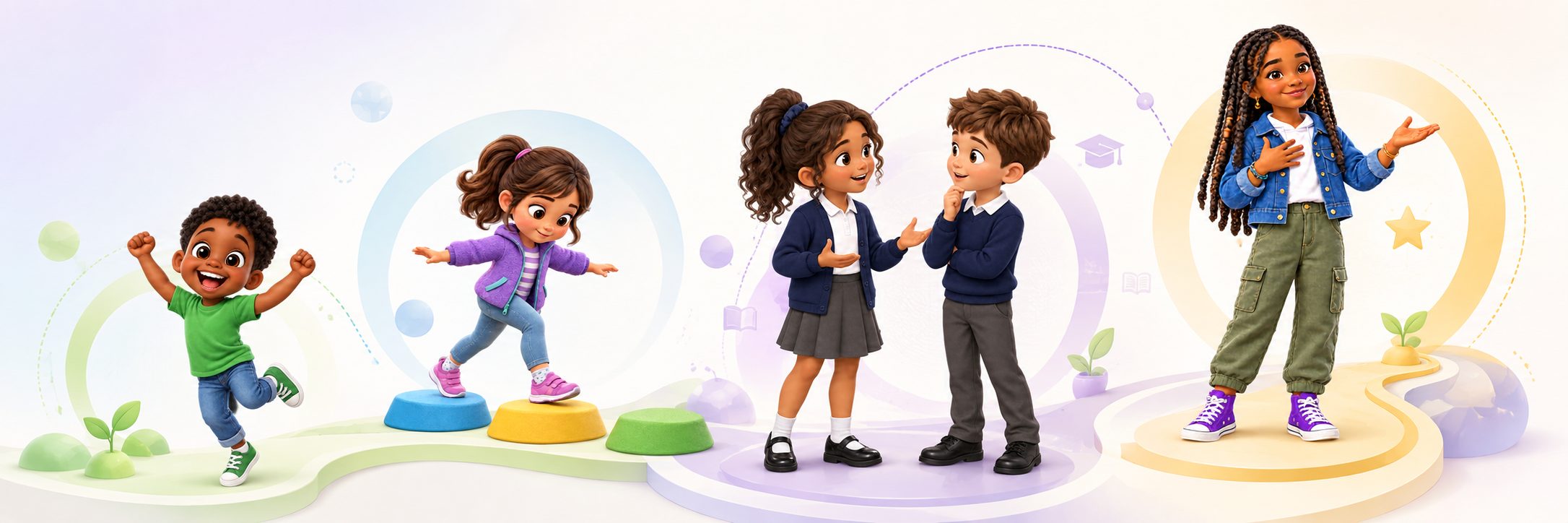
What if we stopped waiting for children to struggle before giving them the skills they need to meet life? Help us bring psychological fitness to more young people, parents, teachers and communities.
Better prepared for life. Build psychological fitness.
