Psychological fitness is not something we complete. It is something we continue to build.
I have been teaching, practising and applying the skills of psychological fitness for more than twenty years. I understand the theories. I know the frameworks. I can explain the relationship between thoughts, feelings and behaviour. I can recognise catastrophic thinking, reframe an unhelpful belief and name a range of ways to regulate and recover.
And still, when something genuinely difficult happens, I can find myself back at the drawing board.
Not because the skills have failed.
Not because I have failed.
But because I have never applied those skills to this particular situation before.
A new challenge may touch a different fear. A loss may reach a deeper part of us. A family change may place us in a role we have never occupied. What helped us at work may not come easily at home. What we could do for a friend may feel much harder when it is our own child, partner or future at stake.
We are not simply retrieving information we already know. We are learning how to use it in new emotional territory.
That is where psychological fitness becomes real.
Knowing is not the same as being able to do
We sometimes treat learning as though understanding an idea should be enough.
We attend a course, read a book or hear a useful explanation and think, Yes, I know that.
But knowing that breathing can help us settle is not the same as remembering to breathe when our body is flooded with fear.
Knowing that thoughts are not always facts is not the same as questioning a frightening prediction at three o’clock in the morning.
Knowing that connection matters is not the same as reaching out when we feel ashamed, overwhelmed or convinced that we should manage alone.
Knowing that feelings carry information is not the same as making room for anger, grief, jealousy or disappointment without allowing them to run the whole show.
The distinction matters because practical skills are learned differently from facts.
You can understand the principles of driving without being able to drive safely through an unfamiliar city in heavy rain. You can learn the notes of a piece of music without being able to play it confidently in front of an audience. The component parts have to be practised, combined and adapted until we can use them under different kinds of pressure.
The same is true of psychological fitness
In Raise Resilience: Teach your teenager well, we describe learning the skills one by one, then practising them until they can be combined with greater ease. We call this the “spiral effect”: sometimes one skill is enough; more complicated experiences require several skills woven together. Mastery is not merely remembering the framework. It is learning which skill to use, when to use it and how to adjust it to the situation in front of us.
The mental-muscle comparison has limits—but it is useful
We often say that psychological fitness is built in the same way as physical fitness.
The comparison is not perfect, but it helps.
We would not expect one walk, one gym session or one healthy meal to make us physically fit for life. We understand that strength is developed through repeated effort. Muscles grow because they are used, challenged, rested and used again.
Neither would we expect physical strength developed in one activity to prepare us perfectly for every other demand. Someone may be a strong runner and still find swimming difficult. A person may be able to lift heavy weights but struggle with balance or flexibility. Existing fitness helps, but a new activity requires fresh learning.
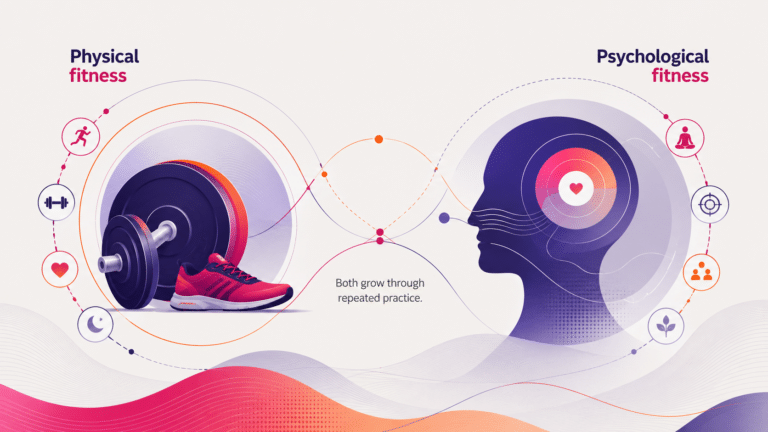
Psychological skills work in a similar way.
The ability to stay calm during an everyday disagreement does not mean we will immediately know how to respond to bereavement, illness, redundancy, betrayal or a child in distress. Previous practice gives us a foundation, but the new situation asks something new of us.
We may need to slow the process down again.
- What am I feeling?
- What am I telling myself?
- What matters most here?
- What is within my control?
- What would help me settle enough to think?
- Who can I talk to?
- What is one useful next step?
Returning to those questions is not evidence that we have gone backwards. It is how we build the capacity to meet a wider range of life experiences.
Habits create a way back in
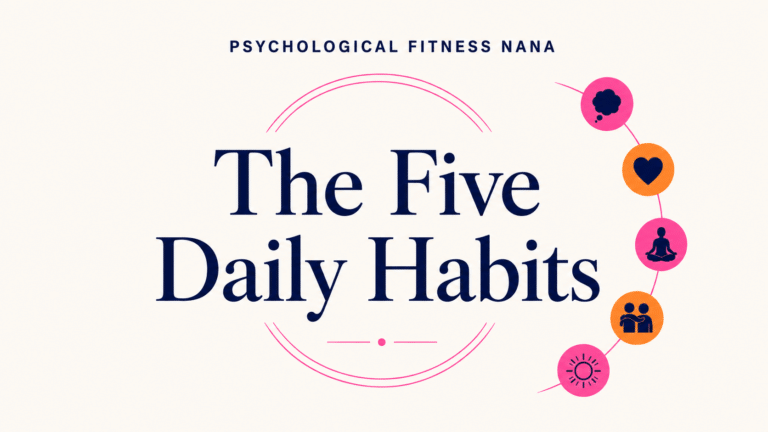
This is why I have become increasingly interested in the Five Daily Habits of Psychological Fitness:
- Notice One Belief
- Name That Feeling
- Practise Stillness
- Reach Out and Connect
- Name the Good Stuff
These habits are deliberately simple. They are not the whole body of psychological fitness. They are the doorway.
Each one offers a small, repeatable way to bring a deeper skill into ordinary life.
Notice One Belief invites us to catch a thought that may be shaping our reaction. It does not demand that we analyse every thought or force ourselves into positivity. It simply creates a little space between what happened and the meaning we have attached to it.
Name That Feeling helps us recognise what is happening internally. Naming an emotion does not make it disappear. It gives us information and makes it less likely that the feeling will drive our behaviour without our awareness.
Practise Stillness is the habit of pausing long enough to have a choice. Sometimes that involves breathing or sitting quietly. Sometimes it means walking, writing, praying, stretching, making something or stepping away before responding.
Reach Out and Connect reminds us that psychological strength is not the same as self-sufficiency. Strong people seek perspective, ask for help and allow themselves to be supported.
Name the Good Stuff trains our attention to notice what helped, mattered or went well. It does not deny what is painful. It prevents difficulty from becoming the only thing we can see.
The Psychological Fitness Nana Guide frames these as small practices that help families regulate, recover and adapt. It also makes an important distinction: the habits are not tasks to perform perfectly. They are daily drills for a stronger mind, returning us to the skills in manageable, human ways.
Habits do not remove thought. They make helpful action more available
Psychological Fitness Nana
A habit begins when a behaviour is repeated often enough in a recognisable context that it becomes easier to initiate.
This does not mean every psychological response should become automatic. Human situations are too complex for that. We do not want people applying a rigid technique regardless of what is happening.
The aim is to make the starting point more familiar.
- When tension rises, can I learn to pause?
- When my mind races ahead, can I notice the story I am telling myself?
- When I withdraw, can I recognise that connection might help?
- When a day has been difficult, can I still identify one thing that supported me?
Repeated practice strengthens the likelihood that we will remember these options when we need them. We build routes back to ourselves.
Some days the habit will be a thoughtful conversation. On another day it may be one breath before answering. Sometimes it will be recognising, several hours later, that we reacted from fear. Even that moment of recognition matters, because awareness gives us something to work with next time.
The smallest practice completed is usually worth more than the perfect plan that never quite begins.
Failure is not the opposite of growth
We need to be much more honest about what practising these skills looks like.
- It includes getting them wrong.
- It includes remembering the helpful response after we have already shouted.
- It includes knowing we need to reach out and then avoiding the call.
- It includes recognising an unhelpful thought and continuing to believe it for a while.
- It includes responding brilliantly on Tuesday and barely holding things together by Thursday.
This is not evidence that psychological fitness is ineffective. It is the practice ground.
When a skill does not work as expected, we can become curious:
- Did I use the wrong skill?
- Was I too emotionally activated to use it yet?
- Did I need support rather than another strategy?
- Was I trying to make the feeling disappear instead of listening to it?
- Was the situation more complicated than I first understood?
- What might I try differently next time?
In the book, we encourage people to move beyond their comfort zone into a stretch zone and experiment. When something does not work, it becomes useful learning: an opportunity to “fail well.”
That is a very different message from perfection.
It says: you are allowed to be a learner here.
The skills have to travel.
A skill only becomes truly useful when it can travel with us
We may first practise it in a calm workshop, at a kitchen table or while completing a written exercise. Then we need to take it into real life:
- into the school run;
- into a difficult meeting;
- into a medical waiting room;
- into an argument with someone we love;
- into a sleepless night;
- into parenting a child whose needs are different from our own;
- into a period of uncertainty when there is no tidy solution.
We also have to practise across levels of intensity.
It is easier to notice a belief when the consequence is mild. It is much harder when we feel threatened, rejected or frightened. That is why the smaller moments matter. They allow us to rehearse before the bigger moments arrive.
But even extensive practice does not mean we will always respond perfectly when life becomes painful. Big situations often require us to return to the skills slowly and deliberately. They may require several skills, repeated over days, weeks or months. They may also require professional, medical or therapeutic support.
Psychological fitness is not a promise that we will handle everything alone. Reaching out is one of the skills.
There is no final stamp of psychological fitness
Perhaps one of the most unhelpful ideas we carry is that personal growth should eventually be completed.
We imagine reaching a point at which we are resilient, regulated, confident or emotionally intelligent—as though someone might stamp a certificate and declare the work finished.
There is no such point.
We can certainly make enormous progress. We can become steadier, more flexible and more able to recover. We can understand ourselves better, communicate more clearly and make wiser choices. We can build genuine confidence based on evidence that we have faced hard things before.
And then life happens.
Something changes. Someone leaves. A relationship shifts. Our health alters. Our children enter a new stage. A responsibility arrives that we did not choose. An old wound is touched by a new experience.
Life does not erase what we have learned, but it may ask us to learn again at a different depth.
That is not regression. It is development.
Growth is not a straight line leading to a finished version of ourselves. It is a widening capacity to meet life: sometimes with confidence, sometimes with help and sometimes by going right back to the beginning.
A proactive approach to mental health
This way of thinking has important implications for the wider mental-health narrative.
For too long, our dominant language has begun with illness, deficit and dysfunction. We often wait until someone is struggling significantly before offering knowledge, language or support.
Medical care is vital. Diagnosis, treatment, therapy and specialist services save and improve lives. Psychological fitness is not a substitute for them.
But the medical approach cannot be the whole of our mental-health strategy.
We also need an educational, developmental and strengths-based approach—one that helps people build useful capabilities before crisis, alongside treatment when it is needed and throughout recovery afterwards.
Psychological fitness begins with the understanding that people possess strengths, can learn and can grow. It asks not only, What is wrong? but also:
- What is happening?
- What skills would help?
- What strengths are already present?
- What can be practised?
- What support is needed?
- What can be learned from this experience?
- How might this person regulate, recover and adapt?
This is proactive mental health. It does not pathologise the normal difficulty of being human. Nor does it minimise suffering. It gives people a language and a set of practical tools with which to participate in their own lives.
As we write in Raise Resilience: Teach your teenager well, prevention is better than cure—but education is better than prevention. Psychological education gives people something active to draw upon, rather than asking them merely to avoid becoming unwell.
Begin small. Then go deeper.
The Five Daily Habits are not the destination.
They are a practical window into a much deeper body of learning.
- One belief noticed may lead us into understanding patterns of thinking.
- One feeling named may begin a richer understanding of emotional regulation.
- One moment of stillness may reveal the difference between reacting and choosing.
- One act of connection may challenge the belief that we must cope alone.
- One good thing noticed may begin to strengthen realistic hope and optimism.
The invitation is not to master all of this at once.
It is to begin, practise, get it wrong, reflect, repair and try again.
Use the skills when life is calm, so they are more available when life is not. Use them in different relationships and different places. Return to them when an unfamiliar experience knocks you sideways. Resist the temptation to say, I know that already.
Ask instead:
- How does this skill apply here?
- That question keeps us learning.
Psychological fitness is not proof that life can no longer floor us. It is the growing knowledge that, when it does, we have somewhere to begin.
And sometimes, beginning again is the strongest thing we can do.
This is psychological fitness.