Last night I watched Channel 4's The Great ADHD Myth?
It will undoubtedly provoke strong reactions. Its central question — whether ADHD is a genuine neurodevelopmental disorder or a social construct — is deliberately challenging.
I don't want to enter the argument about whether ADHD is “real”. ADHD is recognised by the NHS and NICE, and for many children, young people and adults, diagnosis brings important understanding, recognition and access to support.
That question reaches far beyond ADHD.
We have become very practised at locating difficulty within individual children. We assess them, measure them, diagnose them and intervene around them.
We are much less practised at applying the same curiosity to the ecosystem in which that difficulty is showing up.
We built the system
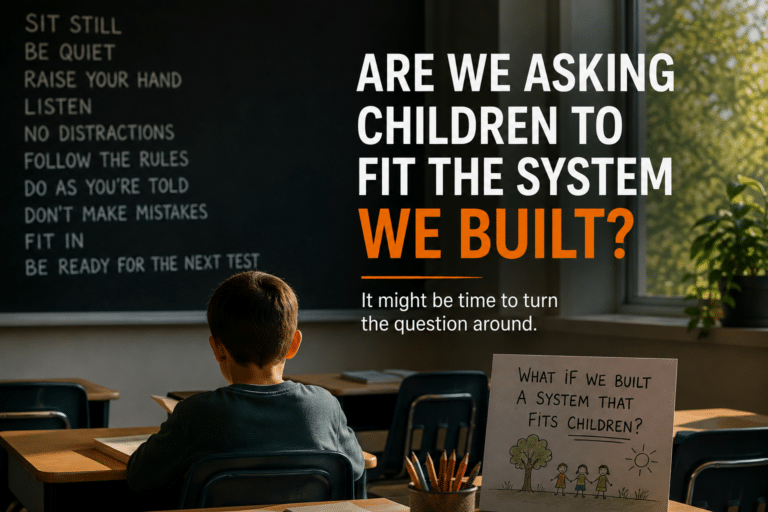
Much of our education system asks children to do some very particular things.
- Sit still for significant periods of time.
- Direct attention towards what someone else has decided matters at that moment.
- Move when a timetable tells them to move.
- Stop moving when it tells them to stop.
- Learn alongside others largely because they happen to have been born within the same twelve-month period.
- Progress through content at predetermined points.
- Demonstrate what they know in particular ways.
- Manage noise, relationships, transitions, pressure, comparison and increasingly high expectations while doing all of the above.
Some children navigate that environment relatively easily.
Others don't.
And when they don't, our instinct is often to look first at the child.
Why can't they concentrate?
Why can't they regulate their behaviour?
Why can't they sit still?
Why aren't they keeping up?
What support does this child need to function more successfully in school?
That can be an entirely appropriate question. Children have different needs, and some need specialist support.
But it cannot be our only question.
The environment belongs in the conversation
Recognising the role of environment does not mean denying neurological difference.
A child can have ADHD and be in an environment that makes concentrating or regulating substantially harder.
A child can have no diagnosis at all and find the demands of a particular environment difficult.
A child can need individual support and the system around them can need to change.
Those things can all be true at the same time.
But there is an imbalance in where we place our attention.
When something isn't working, the individual child is often examined in extraordinary detail — their behaviour, attention, attainment, regulation, needs and differences.
Yet the adults, relationships, expectations, structures, culture and physical environment surrounding that child are rarely examined with the same intensity.
Yet we have built an extraordinary amount of infrastructure around identifying, assessing and intervening when an individual child struggles.
We are less practised at turning the lens around.
What are we asking children to adapt to?
What are the adults around them modelling?
What does the environment reward — and what does it make harder?
Is what we are asking developmentally appropriate?
What does the evidence tell us about how children learn, regulate, connect and develop?
And has the design of education kept pace with that understanding?
Perhaps we have the direction of adaptation wrong
Education inevitably requires structure. This is not an argument for removing boundaries, expectations or challenge.
Quite the opposite.
Children need environments that stretch them. They need to learn how to concentrate when something isn't immediately interesting, tolerate frustration, manage impulses, work with other people and persist when something is difficult.
Those are important capabilities for life.
And preparing children for life should not mean simply making them better able to tolerate a system we happened to build.
That distinction matters.
Because when the prevailing question is “How do we make this child fit?”, we risk treating understandable responses to environment as deficits located entirely within the child.
If we repeatedly locate difficulty in the child while leaving the ecosystem largely unquestioned, we risk trying to change children to solve problems that may be, at least partly, relational, environmental or systemic.
And sometimes the better question is:
Support shouldn't have to begin with a label
There was something else the programme made me think about.
How often does a child have to struggle significantly before we alter what is happening around them?
Sometimes a diagnosis opens the door to adults doing things we could arguably have been doing already.
- More movement.
- Clearer instructions.
- Different ways of demonstrating learning.
- Greater understanding of regulation.
- Thoughtful transitions.
- Predictability where it helps.
- Choice where it matters.
- Attention to relationships and belonging.
- Opportunities to understand themselves.
This isn't an argument against diagnosis. Diagnosis can be enormously important.
It is an argument against making difficulty the gateway to development.
Why wait until children are struggling before helping them understand attention, emotion, thinking, behaviour, relationships and recovery?
Why wait for a referral before creating environments that recognise human variation?
Why make support something a child has to qualify for before asking whether what we are providing works for them?
From deficit to development
This is where I believe the conversation about psychological fitness matters.
Psychological fitness is not a treatment for ADHD. Nor is it an alternative to appropriate clinical support.
It is about developing, throughout childhood and beyond, the capabilities that help human beings navigate life: understanding emotions, regulating responses, thinking flexibly, recovering from setbacks, maintaining hope, developing confidence, connecting with others and knowing when and how to seek support.
But critically, we shouldn't think of those capabilities as things we simply teach to children.
This is why I increasingly think in terms of the ecosystem around a child.
Development doesn't happen inside an individual, separate from everything around them. It happens through the continual interaction between the child and the people, relationships, expectations, experiences and environments that surround them.
Children are developing these capabilities all the time through the environments they inhabit.
Through the adults they observe.
Through the relationships they experience.
Through what gets rewarded.
Through what gets punished.
Through whether mistakes are treated as part of learning or evidence of failure.
Through whether emotions can be understood or need to be hidden.
Through whether asking for help is normal.
Through whether there is room for difference.
Through whether they experience agency as well as instruction.
Which means every school is already shaping psychological fitness, whether it intends to or not.
Turn the question around
Perhaps when a child is struggling, alongside asking:
What does this child need?
we should routinely ask:
What might we need to change?
Not instead.
As well.
That is an important difference.
Because children do need to develop the capacity to navigate a world that will not always organise itself around them.
But adults have responsibilities too.
We design their schools.
We set the expectations.
We determine much of their day.
We create the measures of success.
We shape the relationships and culture surrounding them.
And because we created the system, we also have the ability to change it.
The Great ADHD Myth? will generate debate about diagnosis, medication and what ADHD is.
Those conversations matter.
But I hope it generates another conversation too.
Perhaps the question isn't whether more children need to change. Perhaps it is whether the environments we have built for children have kept pace with what we now understand about human development.
If increasing numbers of children are finding it difficult to fit the system, we should absolutely remain curious about what those individual children need.
But we should be equally curious about the ecosystem they are developing within — and about our own role in shaping it.