Optimism Is a Choice. Positive Thinking Is Not Enough
Optimism is often misunderstood.
It gets confused with being cheerful. Looking on the bright side. Finding the silver lining. Telling people everything will work out.
But real optimism is not the same as positive thinking.
Positive thinking can become a gloss. At its worst, it can encourage people to deny difficulty, minimise risk, ignore pain or silence the very information they need to pay attention to.
Optimism is different.
Optimism is wedded to reality.
It looks difficulty in the eye and still asks:
- Where will I place my attention now?
- What can I influence?
- What is the next useful step?
- What else might also be true?
That is not pretending. That is psychological fitness.
Optimism is not the absence of fear, sadness, frustration or disappointment. It is the choice to notice those emotions, understand what they are telling us, and then decide where to focus our intention — even if only for a few moments.
That choice matters.
For children.
For adults.
For schools.
For youth organisations.
For sports clubs.
For workplaces.
For every organisation that depends on people thinking clearly, recovering well and staying connected under pressure.
Positive emotion is useful. Positive thinking can be risky.
Positive emotion has a powerful role in how we function.
When we feel safe, interested, hopeful, connected or proud, our brain is more available for thinking, learning, problem-solving and creativity. Positive emotion can widen our capacity. It can help us see more options, connect with others, recover energy and move towards possibility.
That does not mean we should try to feel positive all the time.
It means positive emotion can be used as a tool.
The point is not to paste happiness over difficulty. The point is to understand that our emotional state affects what we can access in ourselves.
When we are frightened, ashamed, exhausted or under threat, our attention narrows. We protect. We defend. We avoid. We react.
When we are steadier, even briefly, we can think more flexibly. We can listen better. We can problem-solve. We can choose a response rather than be driven entirely by the first impulse.
Positive emotions are not a luxury to pay attention to once the important work is done. They support intellectual, physical, social and psychological capacity: including creativity, problem-solving, learning, relationships, resilience and goal-setting.
This is where organisations working with young people have a huge opportunity.
The emotional climate around children and young people is not separate from learning, behaviour, performance or belonging. It shapes them.
A classroom, club, team or youth setting that creates steadiness, connection and realistic hope is not being soft. It is creating better conditions for growth.
Optimism starts with Attention
Optimism is a choice about attention.
Not a one-time decision. Not a personality trait some people have and others do not. A repeated, deliberate habit.
When something difficult happens, our minds move quickly.
A young person gets something wrong and thinks, “I’m useless at this.”
A team loses and thinks, “We always mess it up.”
A teacher has a hard lesson and thinks, “I’m not getting through to them.”
A parent sees their child struggling and thinks, “I’ve failed.”
A coach sees a young person withdraw and thinks, “They don’t care.”
Those thoughts may feel true. They may contain some truth. But they are rarely the whole truth.
Optimism creates a pause.
It asks:
- What happened?
- What am I making this mean?
- Is this the whole story?
- What else might also be true?
- What is in my control?
That is reframing.
Not spin. Not denial. Not forced positivity.
Reframing is the habit of thinking flexibly and realistically. It recognises that our thoughts can become habits; useful shortcuts at times, but also biased, incomplete or obstructive. When our thinking is accurate, we have more choices. We can look for what we may have missed, think differently and take more control of the situation.
That is optimism in practice.
Emotions are not the problem. They are information.
Optimism also requires emotional honesty.
We cannot choose where to place our attention if we are pretending we do not feel what we feel.
Anxiety may be telling us something matters.
Anger may be telling us a boundary has been crossed.
Sadness may be telling us something has been lost.
Excitement may be pointing towards opportunity.
Pride may be helping us register progress.
Emotions are signals. They prepare us for action. The work is not to suppress them or let them run the whole show. The work is to harness them.
That requires skill.
Sometimes we need to settle the body.
Sometimes we need to write things down.
Sometimes we need to move.
Sometimes we need connection.
Sometimes we need imagination, stillness or a different perspective.
This is why psychological fitness is practical. It does not ask people to “be positive”. It gives them ways to regulate, recover and adapt.
Strategies for harnessing emotions can include bodily approaches such as breathing or stillness, cognitive approaches such as reframing or journalling, connection with others, imagination and physical movement.
For organisations working with young people, this is especially important.
A school cannot simply tell pupils to be resilient.
A sports club cannot simply tell young players to bounce back.
A youth organisation cannot simply tell young people to make good choices.
A workplace cannot simply tell staff to stay positive.
People need the skills underneath the words.
Optimism builds self-efficacy
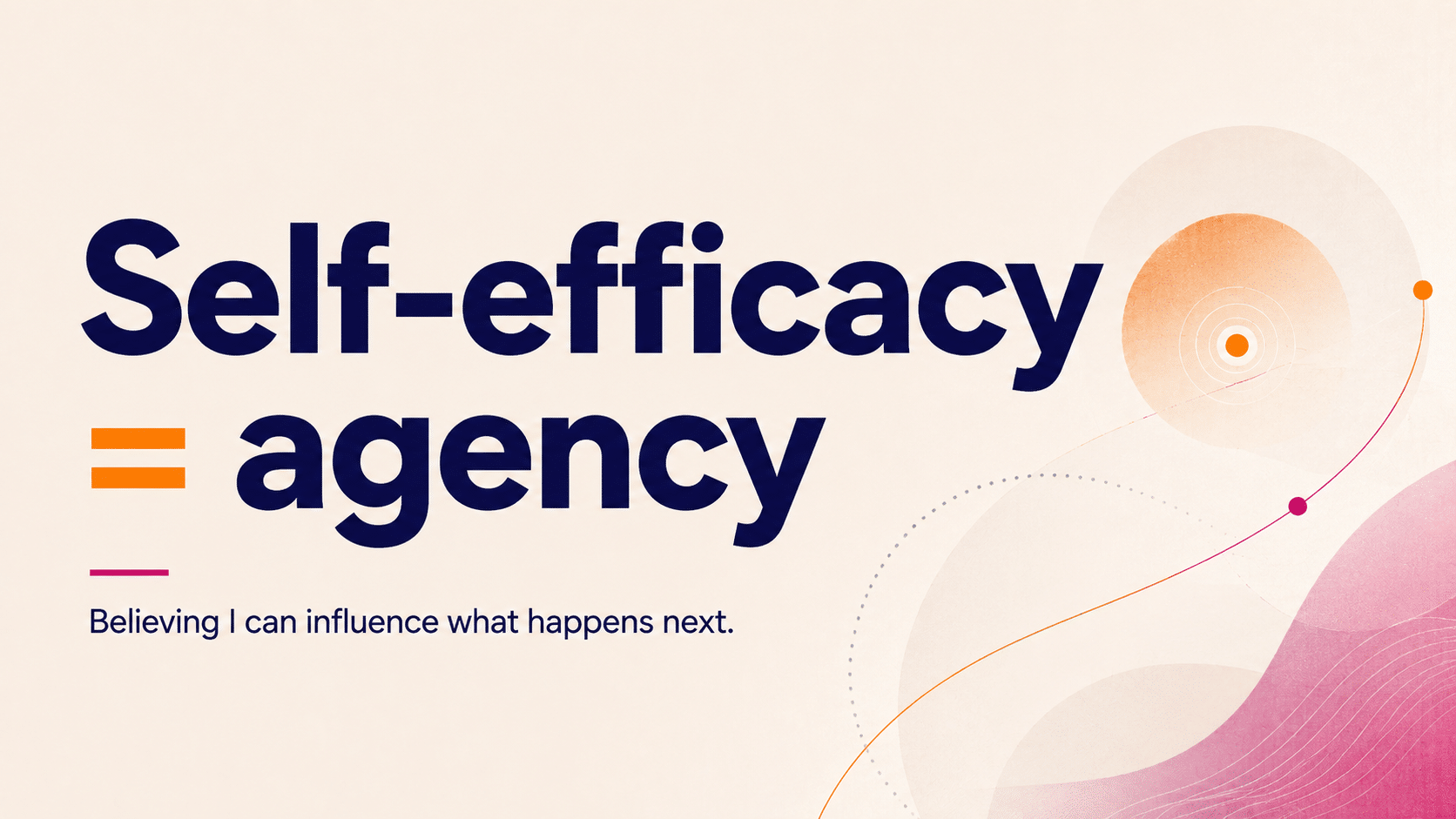
One of the most powerful outcomes of optimism is self-efficacy.
Self-efficacy is not a general sense of feeling good about ourselves. It is the belief, grounded in experience, that I can influence what happens next.
That distinction matters.
A young person does not build self-efficacy by being told, “You’re amazing.”
They build it when they see evidence:
I tried something difficult.
I found another way.
I asked for help.
I recovered after a setback.
I practised and improved.
I handled the moment better than last time.
The same is true for adults.
Self-efficacy grows when people can connect effort, strategy, support and progress. It grows when adults notice the process, not just the outcome. It grows when setbacks are treated as information, not identity.
Optimism feeds this because it keeps the possibility of agency alive.
It says:
This is hard, and I still have choices.
This has gone wrong, and I can learn something.
This is not what I wanted, and I can take the next step.
This feeling is real, and it does not have to decide everything.
The psychological fitness material places self-efficacy alongside other core “superpower” skills, including empathy, process praise, optimism and communication.
That is why optimism is so much more than a nice mindset.
It is a route into capability.
Why this matters for organisations
The organisations around children and young people shape the habits they practise.
Every school, youth organisation, sports club and workplace has an emotional culture.
Some cultures teach people to hide struggle.
Some teach them to perform confidence.
Some reward certainty more than curiosity.
Some talk about resilience but leave people alone to figure it out.
Some unintentionally make difficulty feel like failure.
But psychologically fit cultures do something different.
They help people tell the truth usefully.
They allow difficulty to be named without becoming the whole story.
They make space for emotions without letting behaviour become harmful.
They teach reframing without minimising reality.
They use positive emotion deliberately to build energy, connection and possibility.
They help people notice progress, build self-efficacy and return after things go wrong.
That is fresh wellbeing.
Not a bolt-on. Not a poster. Not a one-off session. Not a forced positivity campaign.
A practical way to build healthier people and stronger performance.
Because when people are psychologically fit, they are more able to think, learn, connect, adapt, recover and contribute.
Optimism is not pretending the world is easy
The world is not easy.
Children and young people are growing up with complexity, noise, pressure and uncertainty. Adults are working in systems that are stretched, fast-moving and often emotionally demanding.
Optimism does not ask us to ignore that.
It asks us to stay in relationship with reality without surrendering all our attention to fear, threat or helplessness.
It asks us to choose, deliberately and repeatedly, where to place our focus.
Not forever.
Not perfectly.
Sometimes just for a few moments.
A moment of noticing what is still possible.
A moment of remembering what has helped before.
A moment of reaching out.
A moment of naming what is good as well as what is hard.
A moment of choosing the next useful step.
That is optimism.
Not positive thinking.
Psychological fitness.