Nearly twenty years ago, Bounce Forward did not begin with a brand, a programme or a business plan.
It began with a question.
In 2007, that question became part of a pioneering research project driven Lord Richard Layard involving Hertfordshire County Council, Manchester City Council and South Tyneside, the University of Pennsylvania and the Department for Education. The Penn Resilience Programme was brought to UK schools and tested with young people.
The findings gave us reason to keep going. There were measurable improvements in areas including depression symptoms and attendance, with important findings for some of the young people facing greater disadvantage.
But research findings sitting in a report were never enough.
The bigger question became:
That question has shaped everything that followed.
From research partner to practical change
What became Bounce Forward first grew from inside Hertfordshire County Council under the name How to Thrive.
We worked with the University of Pennsylvania to build a UK training team. The Penn Resilience Programme was embedded across Hertfordshire secondary schools and the learning began to travel beyond the county.
By 2012, we had generated enough income to be financially self-sufficient and helped secure £1.3 million from the Education Endowment Foundation for the next major question: could we build something broader, designed around adolescent development, and understand what happened when young people learned these capabilities throughout their secondary-school journey?
Thousands of young people were followed over several years. Schools were trained. Teachers delivered the curriculum. Independent researchers from the London School of Economics and the National Institute of Economic and Social Research examined the outcomes.
The results were important.
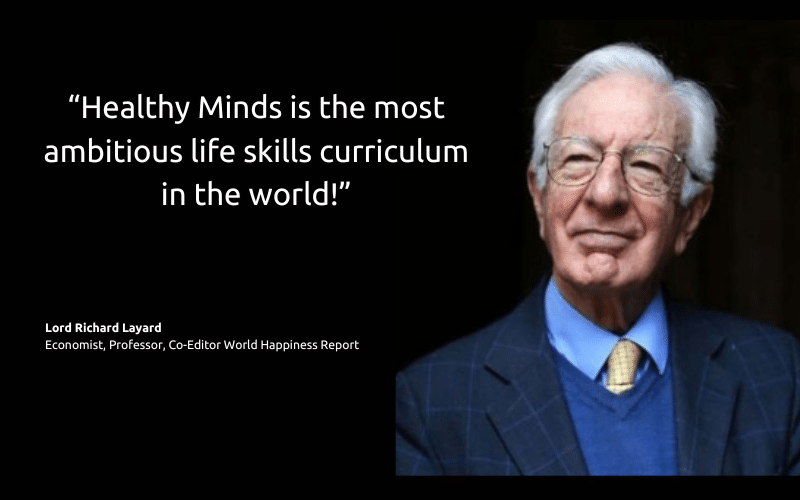
Healthy Minds demonstrated positive effects across areas including general health, physical health, life satisfaction and externalising behaviour, alongside indications relating to absence and exclusions.
Crucially, taking curriculum time to teach these capabilities did not adversely affect academic attainment.
That mattered then.
It matters even more now.
Because almost twenty years later, children are still growing up in systems that measure in extraordinary detail what they know academically while too often waiting until something is wrong before paying equivalent attention to how they are doing psychologically.
We have never believed those things should be in competition.
Becoming independent
In December 2016, the work became an independent charity.
It was an important moment, but independence did not mean certainty.
Quite the opposite.
We were taking evidence developed through public-sector partnership and major research and asking whether a small charity could turn it into sustainable change.
We developed programmes. We trained thousands of teachers and parents. We worked with schools across the country. We learned what schools would buy, what they valued, what they struggled to prioritise and how difficult it could be to secure funding for work designed to prevent problems rather than respond once they had become acute.
And then came setbacks we could never have planned for.
A trademark challenge meant that How to Thrive could no longer continue under the name that had carried the work from its early days.
We had spent years building recognition and credibility.
Then we had to start again.
In 2018, we began the six-month process of rebranding.
At the time, changing our name felt like disruption.
Looking back, it feels strangely fitting.
Because “Bounce Forward” came to describe not simply what we wanted to teach, but something of the organisation itself.
Then the world stopped
Just as the organisation was finding its feet under its new identity, Covid arrived.
Our model depended heavily on bringing people together.
We trained teachers face to face. We worked directly with groups of parents. Discussion, practice, connection and human interaction were central to the way we taught.
Suddenly that model was impossible.
We furloughed staff. We drew on volunteers and pro-bono support. We challenged some of our own assumptions about what could and could not be done online.
And then we rebuilt.
- Training moved online.
- Our resources became digital.
- Webinars replaced rooms.
Our work with parents grew rapidly because families were navigating enormous uncertainty at exactly the moment the support around them had been disrupted.
What could easily have ended the organisation instead changed it.
We have translated psychology into practical ideas that can be used around kitchen tables, in cars, during difficult conversations and in the ordinary moments of family life.
Independent evaluation of that work has repeatedly shown why this matters.
Parents describe pausing rather than reacting, communicating differently, understanding what may sit underneath behaviour and becoming more confident in their own capacity to respond.
One small early evaluation found that 74% of parents felt more resilient after the programme, while 79% of parents who completed pre- and post-wellbeing measures recorded improvement.
Later research with universities including Bristol, Newcastle and UCL explored the feasibility and experience of bringing this learning to parents of secondary-school children and again highlighted communication, parental thinking and practical application within family life.
And the learning continues.
Recent work with families in Oldham shows parents valuing practical strategies, listening differently, better understanding emotions and behaviour, and reflecting on the influence of their own responses.
A small organisation with a very big ambition
Bounce Forward has never had the infrastructure its reach might suggest.
We have operated with small teams, associates, trustees, volunteers and partners. We have experienced financial instability. Different boards have helped steer the charity through different stages of its development. At times we have had to reduce costs significantly simply to protect the work.
Our most recent accounts are transparent about that reality. Income remains modest for an organisation with national reach, funding can be infrequent and unpredictable, and financial resilience remains a challenge.
We do not tell that part of the story to invite sympathy.
We tell it because it matters.
Society spends enormous amounts responding once difficulties become severe, yet securing sustained investment to build capability before crisis remains extraordinarily difficult.
We have lived that contradiction.
And we are still here.
Not because every decision has been right. Not because every programme has worked equally well. Not because the journey has been smooth.
But because we have continued to learn.
- We have listened.
- We have changed.
- We have recovered from setbacks.
- We have adapted our delivery.
- We have followed the evidence.
- We have refused to lose sight of the original question.
In a crowded market, we still choose a different starting point
The wellbeing and mental-health landscape looks very different today from the one we entered almost twenty years ago.
- There is more awareness.
- More provision.
- More language.
- More products.
That progress matters.
But much of the system is still compelled to notice the negative.
We measure symptoms.
We identify problems.
We categorise need.
We refer.
We intervene.
Clinical and specialist services are essential. People need good treatment when they are unwell.
But treatment cannot carry the whole burden.
Our starting point remains different.
That means understanding emotions rather than fearing them.
Learning to regulate rather than suppress.
Thinking flexibly rather than believing every thought.
Recovering after disappointment.
Maintaining realistic hope when the route forward changes.
Building connection.
Recognising strengths.
Developing agency.
Learning that difficulty is part of being human, not evidence that something has gone wrong.
Today we call that psychological fitness.
The language has evolved, but the underlying belief has remained remarkably consistent.
And children cannot build them alone
Perhaps the biggest shift in our thinking over twenty years is this:
We started by asking what skills children needed to learn.
We now understand much more deeply that children develop within an ecosystem.
A child may be taught how to regulate an emotional response, but the behaviour of the adults around them matters.
A young person may learn how to challenge an unhelpful belief, but whether they feel heard and valued within school matters.
A teenager may learn how to ask for help, but the quality of the relationships available when they reach out matters.
That is why our work today is no longer simply about teaching children.
- Young people learn the skills.
- Adults understand and model them.
- Schools, families and organisations create environments in which those capabilities can actually be used.
We have never done this alone
We could never capture every relationship that has mattered to this journey. These are just a few of the many that have helped us learn, grow and reach further.
Our roots with Hertfordshire County Council run back to the beginning of the story.
Our work with Oldham has shown what can happen when a local area invests in building capacity across schools and families.
Our continuing work with Kent and Medway Teacher Training takes psychological fitness into the formation of new teachers — adults who will go on to shape the lives of thousands of young people during their careers.
Recent feedback shows trainees immediately connecting the learning to their own wellbeing, their classroom behaviour, restorative conversations and the way they understand pupils.
We are proud to be part of the Big Change community — a network built around challenging assumptions about what young people need from education and society.
Partnership with Carlsberg Britvic has helped us bring psychological-fitness teaching to primary and secondary schools across England, including work reaching more than 40,000 children through that partnership alone.
Our partnership with the Harry Kane Foundation is built on a shared belief that prevention matters, that positive mental health deserves the same seriousness as physical health and academic success, and that the adults around young people have a vital part to play.
Our work with military families has become another important part of this story. With support from the Armed Forces Covenant Fund Trust, we have worked with RAF, Army and Navy families navigating some of the pressures that are simply part of service life — deployment, separation, repeated moves, uncertainty and the impact those experiences can have on children.
Our Anxiety Unravelled project alone reached 569 military parents and more than 1,300 children, with every parent completing the follow-up evaluation agreeing that the learning had made a positive difference and would help them support their children at home.
Parents have told us how powerful it is to learn alongside others who understand military life, and how practical strategies can make uncertainty feel more manageable.
Why now?
The need for this work has never felt greater.
Young people are growing up amid extraordinary possibility, but also profound uncertainty.
They are navigating academic pressure, economic insecurity, rapidly changing technology, online comparison and influence, changing relationships, geopolitical uncertainty and concerns about what their futures will look like.
The adults around them are navigating many of the same things while trying to provide stability and reassurance.
And our response cannot simply be to become better at identifying who is struggling.
That means moving further upstream.
- Not instead of treatment.
- Not instead of safeguarding.
- Not instead of targeted help.
- Alongside all of them.
We need to ask not only:
Who needs help?
But also:
What strengths already exist here?
What are people experiencing?
What capacities should we deliberately develop?
What relationships should we protect?
What conditions need to change?
What are we building now that will still matter ten or twenty years from today?
Build what lasts
That thinking has led us to the next chapter.
Working collaboratively, we are bringing together insight, interpretation and practical psychological-fitness development to help schools see a fuller picture of their communities.
Not just attainment.
Not just absence.
Not just behaviour.
But happiness, belonging, relationships, confidence, staff experience, family experience and readiness to meet challenge.
The approach is deliberately simple:
- Listen.
- Understand.
- Strengthen.
- Review.
Listen to pupils, staff and families.
Understand the strengths, pressures and patterns beneath the numbers.
Strengthen what matters rather than imposing a generic intervention.
Then return to the evidence and learn what has changed.
In many ways, Bounce Together brings us back to where we started.
Evidence.
Curiosity.
Practical action.
Learning.
But this time with twenty years of experience behind us.
The next twenty years
There are easier stories we could tell about our anniversary.
We could count programmes.
Count schools.
Count participants.
Count partnerships.
Those numbers matter, and we are proud of them.
But they are not the whole story.
It is about taking psychology out of academic papers and putting it into the hands of teachers, parents and young people.
It is about the child who learns that a thought is not necessarily a fact.
The teacher who pauses before reacting.
The parent who listens differently.
The school that decides wellbeing is not something to measure only after it deteriorates.
It is about continuing to believe that human beings can develop throughout life.
And perhaps there is something fitting in the fact that Bounce Forward itself has had to practise what it teaches.
- We have faced uncertainty.
- We have lost things.
- We have changed direction.
- We have had to rethink assumptions.
- We have made mistakes.
- We have recovered.
- We have adapted.
- We have grown through experiences we would never have chosen.
Nearly twenty years after that first research began, our ambition has become bigger, not smaller.
We want psychological fitness to become part of how we think about growing up.
- Explicitly taught to young people.
- Understood and modelled by adults.
- Strengthened within schools, families and communities.
And regarded not as something we reach for only when life goes wrong, but as an essential part of being prepared to live it.
The market around us may be crowded.
The organisation behind the ambition may still be small.
But the question we started with matters more than ever.
Twenty years of research, practice, setbacks, partnerships, learning and lived experience have brought us here.
Now we intend to use that history to help drive what comes next.
Twenty years of learning.
Ten years independent.
Bounce Forward. Build what lasts.